The best Portland, Oregon parks and gardens start in Washington Park, where the free International Rose Test Garden, the Portland Japanese Garden and Hoyt Arboretum sit within a short shuttle ride of each other and a MAX station. Beyond it, Forest Park’s 5,200 acres of trail begin at the city’s edge, Lan Su Chinese Garden fills a city block in Old Town, and the east side adds a volcano you can walk up, a rhododendron garden and a rose garden older than the famous one.
This page is for visitors choosing which green spaces to fit into a trip, and how to reach them without wasting half a day on parking. The caveat: several of the best gardens charge admission and close one day a week, and their hours shift with the seasons, so check the day before. Prices, hours and transit details were checked on September 24, 2026 against the operators’ and agencies’ own websites.
On this page: At a glance · Compare · Washington Park · A day in Washington Park · Forest Park and Pittock · Downtown and the river · East side parks and gardens · Natural areas · By neighborhood · Best views · Getting there · Park rules · Bloom calendar · Accessible options · Time budgets · Rainy days · FAQ
Portland parks and gardens at a glance
| Question | Short answer (checked September 2026) |
|---|---|
| Best single area | Washington Park: Rose Test Garden, Japanese Garden, Hoyt Arboretum, the zoo and more on one hill |
| Free | International Rose Test Garden, Hoyt Arboretum, Forest Park, Mount Tabor, Pittock Mansion’s grounds and every city park |
| Paid gardens | Japanese Garden $22.50 adults; Lan Su $18; Crystal Springs $9; Leach $5, or free on request |
| Book ahead | Japanese Garden tickets up to 10 days ahead; Oregon Zoo tickets must be bought online in advance |
| Closed days | Japanese Garden Tuesdays; Leach Mondays and Tuesdays; Mount Tabor’s roads close to cars on Wednesdays |
| Without a car | MAX Red or Blue Line to Washington Park, then the free shuttle loop to the gardens |
| Best months | April and May for rhododendrons; late May to October for roses; October and November for maples |
If you’re building a whole trip rather than a day outside, our list of things to do in Portland, Oregon puts the parks alongside the museums, markets and neighborhoods.
Which parks and gardens are worth your time?
Portland has hundreds of parks, and most are neighborhood lawns you’d never cross town for. These are the ones that justify the trip, with what they cost and how long they take.
| Place | Cost (2026) | Time to allow | Best season | Getting there |
|---|---|---|---|---|
| International Rose Test Garden | Free | 45-60 minutes | Late May to October | MAX and the free shuttle, or paid parking |
| Portland Japanese Garden | $22.50 adult | 1.5-2 hours | All year; maples in fall | Across the road from the Rose Garden |
| Hoyt Arboretum | Free | 1-2 hours | All year; fall color | Short walk from Washington Park station |
| Lan Su Chinese Garden | $18 adult | 1 hour | All year; winter blooms | Old Town, walkable from downtown |
| Forest Park | Free | 2-4 hours | All year | Lower Macleay trailhead in Northwest |
| Mount Tabor Park | Free | 1 hour | Sunsets, any season | Southeast; walk or bus, or drive except Wednesdays |
| Crystal Springs Rhododendron Garden | $9 adult | 1 hour | April and May | Southeast, near Reed College |
| Leach Botanical Garden | $5, or free on request | 1-1.5 hours | Spring and fall | Outer Southeast; a drive for most visitors |
Verdict: for a first visit, spend a morning in Washington Park on the Rose Garden, the Japanese Garden and a short Hoyt loop, then add Lan Su downtown and Mount Tabor for sunset. Everything else is for a second trip or a special interest.
Washington Park: the Rose Garden, Japanese Garden and Hoyt Arboretum
Washington Park is 410 acres of hillside in the West Hills, and it holds more of Portland’s headline attractions than anywhere else in the city: the International Rose Test Garden, the Portland Japanese Garden, Hoyt Arboretum, the Oregon Zoo and the World Forestry Center. MAX Red and Blue Line trains stop at Washington Park station every 15 minutes, 260 feet underground, the deepest transit station in North America, with elevators to the surface. Driving is fine but not cheap: parking costs $2.40 an hour up to $9.60 a day, enforced from 9:30 a.m. to 8 p.m. every day and paid by kiosk or the ParkingKitty app.
The park’s free shuttle loop links the station with every major stop. From April through September it runs daily from 9:30 a.m. to 7 p.m. every 15 minutes; from October through March, 10 a.m. to 4 p.m. every 30 minutes. It doesn’t run in bad weather, on Thanksgiving or on Christmas Day, and stops are marked with blue Free Shuttle Loop signs.
International Rose Test Garden
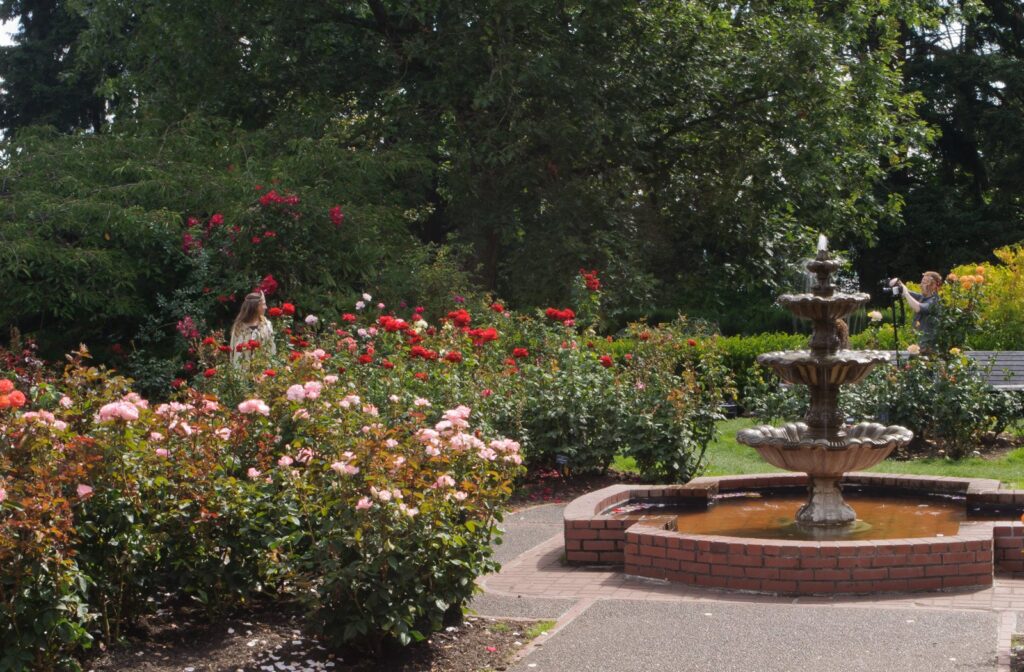
This is the garden that gave Portland its nickname. It has shaped the city’s Rose City identity since 1917 and is the oldest continuously operating public rose test garden in the United States, with more than 10,000 bushes of more than 610 varieties on terraces above downtown. Entry is free, and it’s open from 5 a.m. to 10 p.m., except that from May through August it closes from 5 to 10 a.m. every other Wednesday for maintenance.
The roses bloom from late May into October, peaking in June, when the Rose Festival fills the city; the 2026 festival ran from May 22 to June 28. From Memorial Day to Labor Day a free tour leaves the Rose Garden Store at 1 p.m. daily. Go early in the morning in June, before the tour buses, and look east: on a clear day Mount Hood floats above the city beyond the terraces.
Within the garden, look for the Shakespeare Garden, planted with roses named for characters from the plays, and the Gold Medal garden of past award winners. The lawn amphitheater below the terraces hosts summer concerts, and the Rose Garden Store is the place for the tour and for water on a hot afternoon.
Portland Japanese Garden
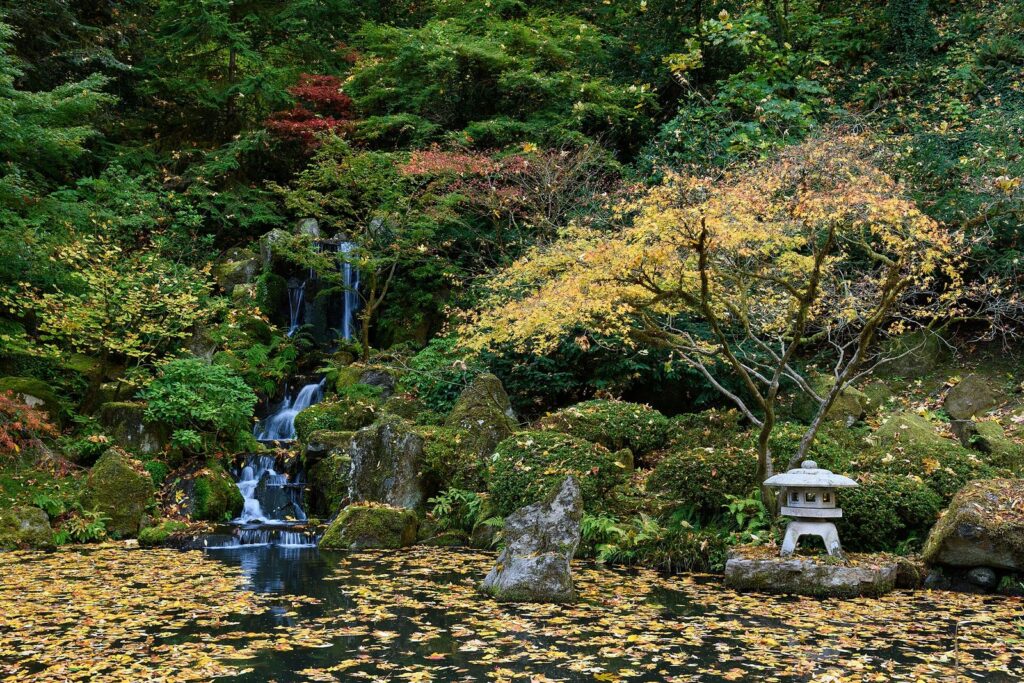
Across the road and up the hill, the Portland Japanese Garden is the paid garden most worth the money. Its grounds hold several distinct garden styles, from raked sand and stone to a strolling pond garden with a waterfall, plus a tea house and a cultural village designed by the architect Kengo Kuma. It’s open Wednesday through Monday from 10 a.m. to 5:30 p.m. and closed on Tuesdays. Adult tickets are $22.50, seniors 65 and over $19.50, students $18.50 and youth 6 to 17 $16.50, with children 5 and under free.
Tickets can be booked up to 10 days ahead, and on fall weekends, when the maples turn red and gold, that’s worth doing. The garden is lovely in rain, too, which is lucky, because it gets plenty of it. Allow an hour and a half, more if you stop at the café.
Hoyt Arboretum
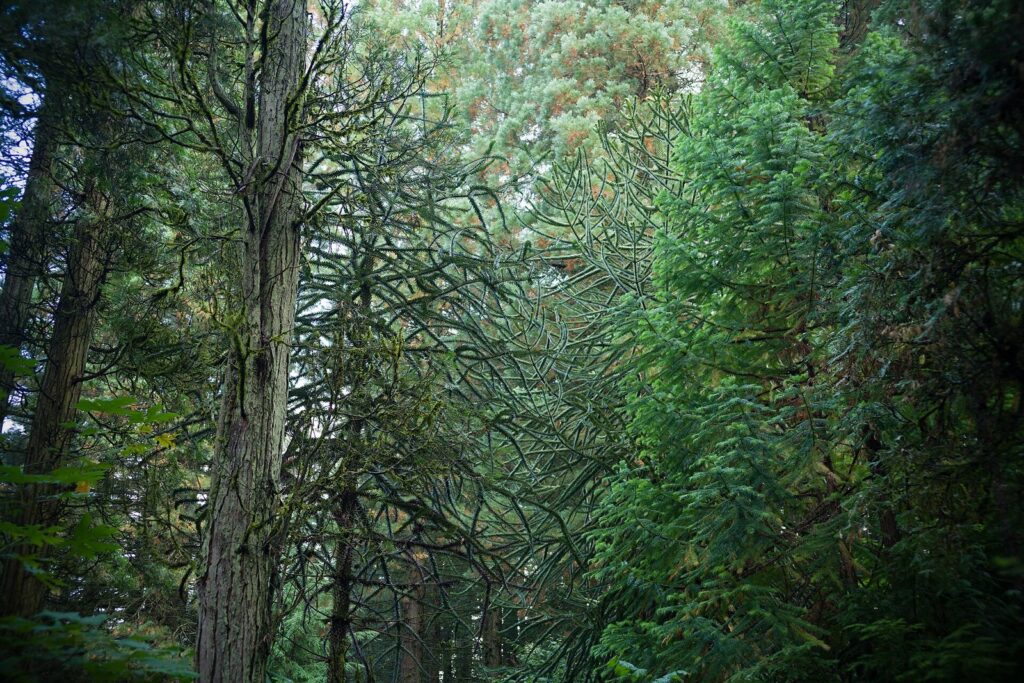
Hoyt Arboretum is a free, 190-acre living museum of trees on the ridge above the zoo, with more than 2,300 species from around the world and 12 miles of trails. Some are paved, most are packed dirt or gravel, and a few have stairs. The Visitor Center at 4000 SW Fairview Blvd opens daily from 10 a.m. to 4 p.m. and has trail maps; the arboretum itself is open every day of the year. A one-hour loop through the conifer collections is the best quiet hour in Washington Park, and in October and November the maples and larches make it one of the city’s best fall walks.
The zoo, the World Forestry Center and the rest
The Oregon Zoo and the World Forestry Center’s Discovery Museum sit together near the MAX station. The zoo requires tickets bought online in advance, up to 30 days ahead: $26 for ages 12 and up and $21 for children 2 to 11 in 2026. The Discovery Museum is smaller and cheaper, $8 for adults, and good for a rainy hour. Our guide to Portland, Oregon with kids covers both, along with the park’s big playground.
Think twice if you’re driving up on a sunny Saturday in June. The lots near the Rose Garden fill early and the roads jam; take MAX and the shuttle instead.
How do you spend a day in Washington Park?
The park rewards an early start and a loose plan. Take MAX to Washington Park station for about 9:30 a.m., ride the elevators up and catch the free shuttle to Hoyt Arboretum for a quiet loop through the conifers before the day warms up. Be at the Portland Japanese Garden when it opens at 10, since its paths are most peaceful in the first hour, and give it an hour and a half.
Walk down the hill to the International Rose Test Garden for late morning, when the light on the terraces is still soft, then eat on a bench or head back down to the city for lunch. With kids, swap the Japanese Garden for the Oregon Zoo and spend the afternoon at the playground. Without kids, finish with a drive or a steep walk up to Pittock Mansion for the view over the city. It’s a full, unhurried day with only one fare each way.
Forest Park and Pittock Mansion
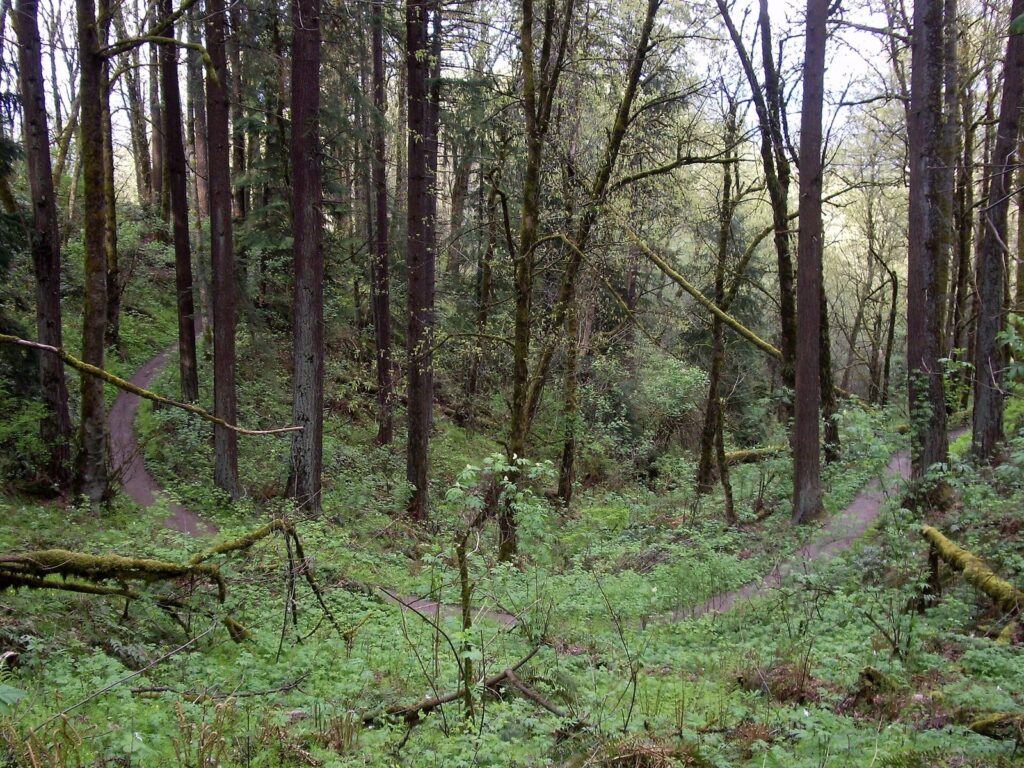
Forest Park is the reason Portlanders talk about having wilderness inside the city limits. It covers 5,200 acres of the West Hills with more than 80 miles of trails, including the 30-mile Wildwood Trail, and it’s open from 5 a.m. to 10 p.m. Dogs must be on a leash and e-bikes aren’t allowed. The easiest entry is the Lower Macleay trailhead in Northwest Portland, which has accessible parking and a creekside trail that climbs gently into the forest. Choosing a specific route is a hiking question rather than a parks one, but for a first visit an out-and-back along Balch Creek shows you what the fuss is about.
About a mile up the Lower Macleay Trail you’ll pass the “Witch’s Castle,” the moss-covered stone shell of an old park restroom, which is where most first-timers turn around. It’s a good turnaround point, too: the trail keeps climbing from there, and the next landmark is Pittock Mansion, a steep hike farther up the ridge.
Pittock Mansion sits on the ridge above, a 1914 French Renaissance-style house whose grounds are a public park, open daily until 9 p.m., with views over the city to as many as five Cascade peaks. Touring the house costs $17 for adults, $15 for seniors and students, $14 for ages 6 to 18 and nothing for children under 6; September hours are 9 a.m. to 4 p.m. (noon on Tuesdays). The main lot was paid from July 2 to September 7 in 2026, with free gravel turnouts nearby. The grounds are the free part and, on a clear evening, the better part.
Downtown and the riverfront
Tom McCall Waterfront Park runs along the west bank of the Willamette through downtown, a long lawn and seawall path that hosts the Rose Festival’s CityFair weekends and the Waterfront Blues Festival, which ran July 2 to 4 in 2026. At its north end, cherry trees line the seawall and bloom pale pink in spring. Across the river, the Vera Katz Eastbank Esplanade runs 1.5 miles from the Hawthorne Bridge to the Steel Bridge, including a 1,200-foot floating walkway, the longest of its kind in the country. Walking one side and returning on the other makes a flat, easy loop of about three miles with the skyline in view the whole way.
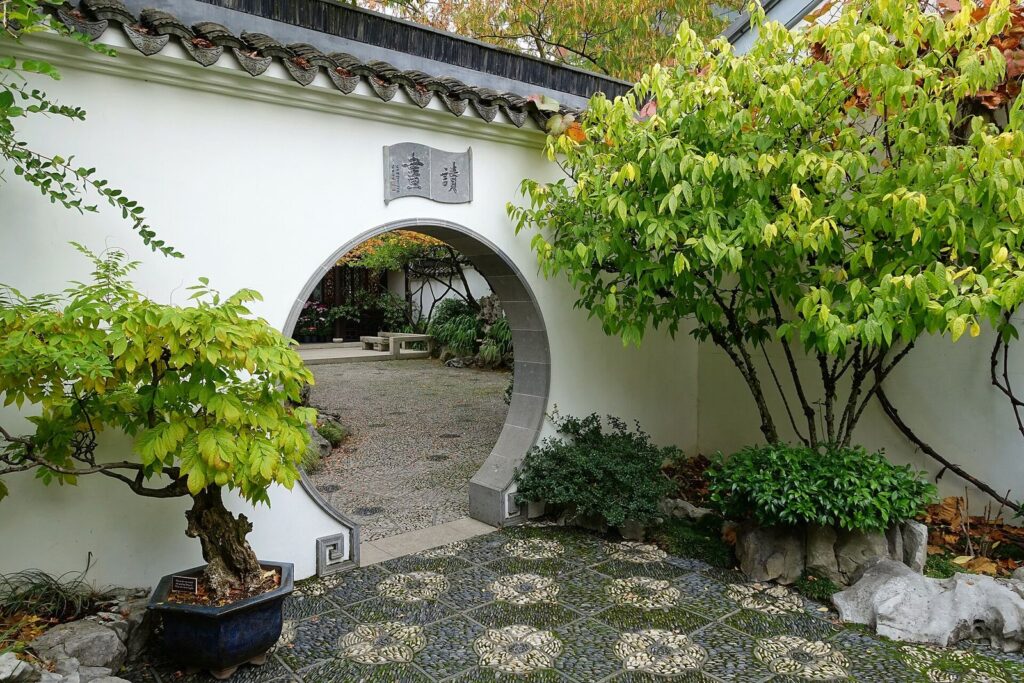
Lan Su Chinese Garden fills a city block in Old Town Chinatown at 239 NW Everett St, a walled garden of courtyards, covered walkways, a lake and the Yun Shui teahouse. It’s open daily from 10 a.m. to 5:30 p.m., with last entry at 5. Adults 19 to 61 pay $18, seniors 62 and over and students $17, youth 6 to 18 $15, and children 5 and under enter free; there’s a free lot next door. Because so much of it is covered, it’s the best garden in the city for a wet day. Artisans from Suzhou, Portland’s sister city in China, built it, and it opened in 2000.
Downtown also has the world’s smallest park. Mill Ends Park, in the median of SW Naito Parkway at Taylor Street, is 2 feet across, held the Guinness record for smallest park from 1971, and became an official city park on St. Patrick’s Day, 1976. It takes 30 seconds to see, which is the joke.
East side parks and gardens
Mount Tabor Park
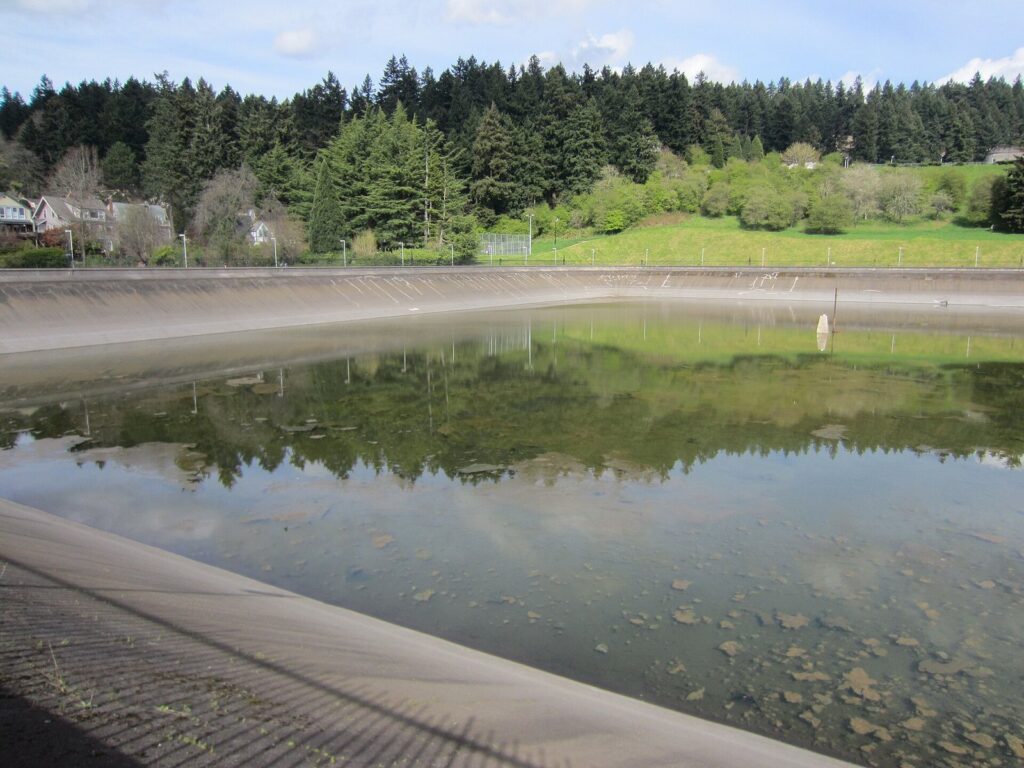
Mount Tabor is a volcanic cinder cone in the middle of Southeast Portland, and its summit park is the east side’s favorite place to watch the sun set over downtown. The city built open reservoirs on its slopes in 1894 and 1911; the three that remain no longer supply drinking water, but their stone gatehouses and fences still frame the walking paths. Trails loop up through Douglas firs to the top.
The park is open from 5 a.m. to 10 p.m. Its roads close to cars all day on Wednesdays, and from 10 p.m. to 5 a.m. on other days, which makes Wednesday the day for walkers, cyclists and anyone who likes an empty road uphill.
Peninsula Park Rose Garden and Laurelhurst Park
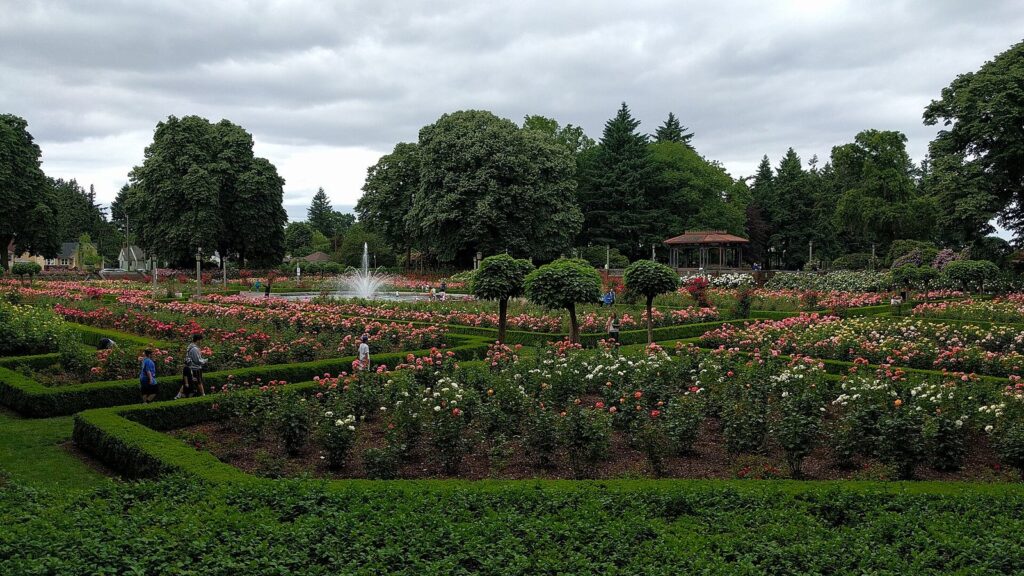
In North Portland, Peninsula Park Rose Garden is Portland’s oldest public rose garden, a sunken formal garden of clipped hedges, rose beds and a fountain. It’s free, it’s quieter than the Washington Park garden, and in June it can be just as good. Laurelhurst Park in Southeast is the classic neighborhood park done well: big old trees, a duck pond and paths that fill with dog walkers and picnics on warm evenings.
Ladd’s Addition and Cathedral Park
Two smaller places reward a detour. In Southeast, the diagonal streets of Ladd’s Addition frame four small public rose gardens, planted in the diamond-shaped blocks, which bloom with the big gardens in June and rarely see a crowd. In North Portland, Cathedral Park sits beneath the St. Johns Bridge, whose Gothic arches give the park its name; it’s the best place to photograph the bridge, especially in morning fog.
Crystal Springs Rhododendron Garden
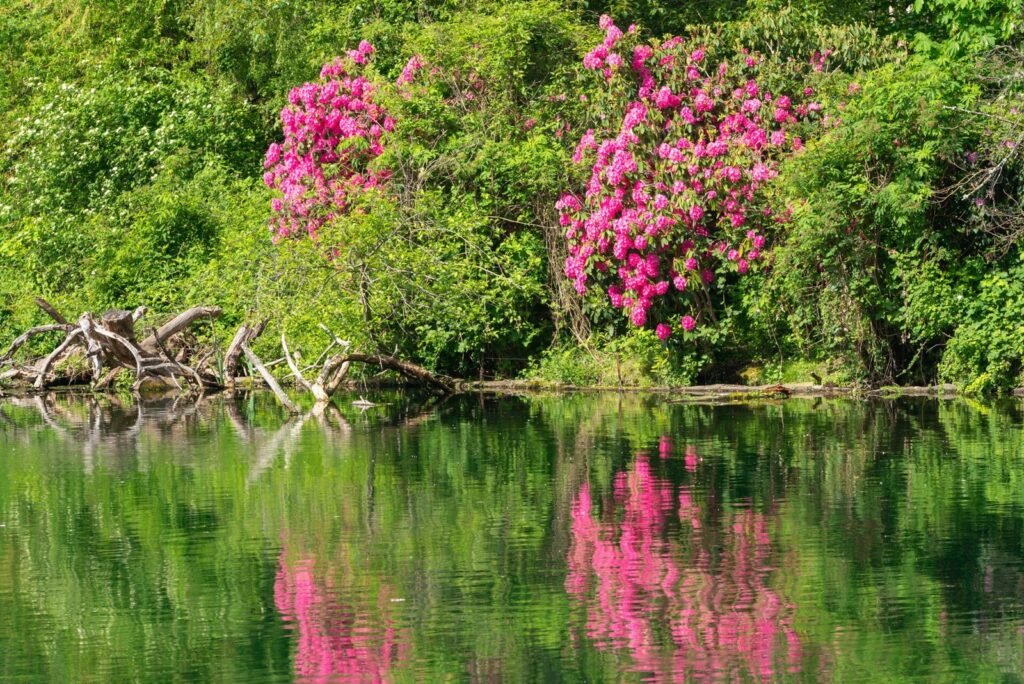
Crystal Springs, at 5801 SE 28th Ave near Reed College, is a spring-fed lake ringed by rhododendrons and azaleas, with ducks, geese and herons on the water. It’s at its best in April and May. Admission is $9 for adults, $8 for seniors 65 and over and $6 for ages 6 to 18, with children 5 and under free; summer hours were 10 a.m. to 5:30 p.m. Thursday through Tuesday and 1 to 5:30 p.m. on Wednesdays, and hours are shorter in the off-season, so check before a fall or winter visit.
Leach Botanical Garden
Leach Botanical Garden, in outer Southeast along Johnson Creek, is the city’s botanical garden of native and woodland plants, with an Aerial Tree Walk in its Upper Garden next to the upper parking area. It’s open Wednesday through Sunday from 10 a.m. to 4 p.m., with last entry at 3:30, and closed Monday and Tuesday. Admission is $5, children 5 and under are free, and the Garden for All program gives free entry to anyone who asks. The main entrance and parking are at 12323 SE Claybourne St. It’s a drive from the center, but the tree walk alone repays it.
Natural areas for walks and wildlife
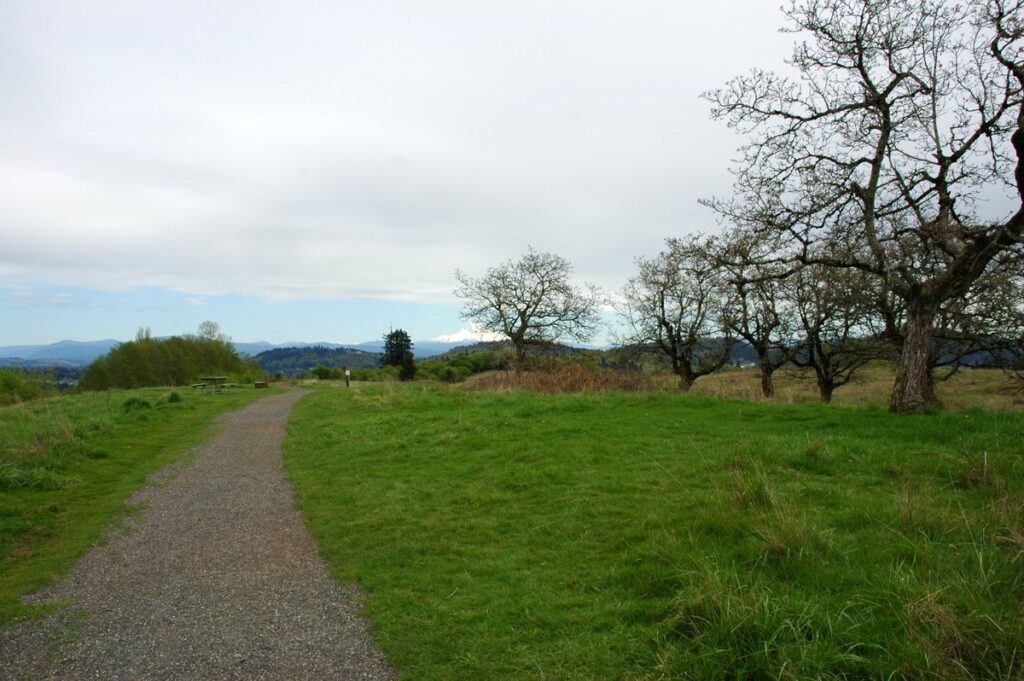
Three more places show a wilder side of the city, each with an easy walk for visitors.
Oaks Bottom Wildlife Refuge, at SE 7th Ave and Sellwood Blvd, is a wetland along the Willamette just north of Sellwood, where herons and ducks share the ponds. From the north parking lot, the paved North Woodland Trail and the Oaks Bluff Trail make an easy one-mile round trip. Dogs must be leashed.
Tryon Creek State Natural Area, off SW Terwilliger Boulevard at the city’s southern edge, is a forested canyon with about 14 miles of hiking trails, 3.5 miles of horse trails open to hikers, a 3-mile paved bike path and a quarter-mile paved, fully accessible trail. The Nature Center is open daily from 9 a.m. to 4 p.m. Park hours follow the daylight: 7 a.m. to 6 p.m. from November through February, stretching to 7 a.m. to 9 p.m. from May through August.
Powell Butte Nature Park, at SE 162nd Ave and Powell Blvd, is an extinct volcano in the far east of the city, with a summit meadow, an old orchard and trails shared by hikers, mountain bikers and horseback riders. On a clear day the meadow looks east toward Mount Hood. Dogs are allowed only on leash and on the trails.
Parks and gardens by neighborhood
If you’re staying in one part of town, this is what’s close by. For what else each area offers, see our guide to Portland, Oregon neighborhoods.
| Area | Parks and gardens |
|---|---|
| West Hills (Southwest) | Washington Park: the Rose Garden, Japanese Garden, Hoyt Arboretum and the zoo |
| Northwest | Forest Park’s Lower Macleay trailhead and Pittock Mansion |
| Downtown and Old Town | Waterfront Park, Lan Su Chinese Garden, Mill Ends Park |
| Inner Southeast | The Eastbank Esplanade, Laurelhurst Park, Ladd’s Addition’s rose gardens, Mount Tabor |
| Sellwood and Reed | Oaks Bottom Wildlife Refuge, Crystal Springs Rhododendron Garden |
| North Portland | Peninsula Park Rose Garden, Cathedral Park |
| Outer Southeast | Leach Botanical Garden, Powell Butte Nature Park |
| Southwest edge | Tryon Creek State Natural Area |
Which parks have the best views?
The views are half the point of Portland’s hills. Pittock Mansion’s lawn looks over downtown to as many as five Cascade peaks on a clear day, the widest panorama in the city. The Rose Garden’s terraces frame Mount Hood above the skyline. Mount Tabor is the east side’s sunset spot, with downtown and the West Hills turning gold across the river, and Powell Butte’s summit meadow looks east toward Mount Hood. Council Crest, the highest point in the city, is a small park at the top of the West Hills with a 360-degree view. All of them depend on the weather, so save them for a clear day and swap in Lan Su or the Japanese Garden when the clouds are down.
How do you get to Portland’s parks without a car?
For Washington Park, take MAX and the free shuttle: it’s faster than driving on busy days and saves the parking fees. Downtown’s riverfront parks and Lan Su are walkable from any central hotel. The east side parks are reachable by bus, bike or rideshare; Mount Tabor, Laurelhurst and Crystal Springs are each a short ride from the inner east side.
BIKETOWN’s e-bikes make the flatter parks easy: in 2026 pay-as-you-go riders paid $1 to unlock plus 35 cents a minute. Shared e-scooters are fine on streets, bike lanes and multi-use paths, but they aren’t allowed inside parks except on park roads and in parking areas, so plan to leave them at the gate. Our guide to getting around Portland, Oregon has the fares, passes and routes.
Dogs, picnics and park rules
Leashes are the rule in Portland’s big parks and natural areas: Forest Park, Oaks Bottom and Powell Butte all require dogs on leash, and at Powell Butte they must also stay on the trail. The paid gardens are different places altogether, so check each one’s rules before bringing a dog. The city parks named here are generally open from 5 a.m. to 10 p.m., and Forest Park, the Rose Garden and Mount Tabor keep exactly those hours.
Picnicking is easy almost everywhere with a lawn, and the city’s food cart pods make a good takeout stop on the way; our guide to Portland food carts lists the pods by neighborhood. One practical warning: trailhead lots at Forest Park and Washington Park are known for car break-ins, so leave nothing visible in the car.
What’s in bloom when?
Portland’s gardens peak at different times, so the right itinerary depends on the month.
| Months | What’s at its best | Where |
|---|---|---|
| January and February | Winter-blooming shrubs, evergreen structure, quiet paths | Lan Su, the Japanese Garden, Hoyt Arboretum |
| March and early April | Cherry blossoms and magnolias | Tom McCall Waterfront Park, Hoyt Arboretum |
| April and May | Rhododendrons and azaleas | Crystal Springs, the Japanese Garden, Leach |
| Late May to July | Roses at their peak; the Rose Festival | Rose Test Garden, Peninsula Park |
| August and September | Late roses, shade walks, long evenings | Forest Park, Mount Tabor, the rose gardens |
| October and November | Japanese maples and fall color | The Japanese Garden, Hoyt Arboretum |
| December | Holiday lights and bare-branch views | ZooLights at the Oregon Zoo, November 20, 2026 to January 3, 2027 |
Rain shapes the calendar too. July and August are the driest months, with about four days of measurable rain each on average, while November through January bring 18 or 19 rainy days a month. For the full month-by-month picture, see the best time to visit Portland, Oregon.
Which parks and gardens work for wheelchairs and strollers?
Several of the city’s green spaces have paved or step-free options, though conditions vary and it’s worth checking with each site before you go:
- Hoyt Arboretum has paved trails near the Visitor Center.
- Tryon Creek State Natural Area has a quarter-mile paved, fully accessible trail and a 3-mile paved bike path.
- Oaks Bottom Wildlife Refuge‘s North Woodland Trail is paved, though it starts downhill from the lot.
- Forest Park‘s Lower Macleay trailhead has accessible parking.
- Washington Park station is reached by elevators, and the free shuttle connects it with the gardens.
- The Eastbank Esplanade and Waterfront Park are flat and paved for their full length.
The Rose Test Garden’s terraces involve slopes and steps between levels, and Mount Tabor’s summit paths are steep, so plan those with extra time.
How much time do you need?
A realistic plan is two or three places a day, not six. Washington Park alone fills a full day if you add the zoo, and a morning if you stick to the gardens. Rough time budgets, including a little wandering:
| Plan | Time | Includes |
|---|---|---|
| Washington Park gardens | A morning, 3-4 hours | Rose Garden, Japanese Garden, a short Hoyt loop |
| Washington Park with kids | A full day | The zoo, the playground, the Rose Garden |
| Downtown and the river | 2-3 hours | Lan Su, Waterfront Park, the Esplanade loop |
| Forest Park and Pittock | Half a day | Lower Macleay trail, then Pittock’s grounds for the view |
| East side | Half a day | Crystal Springs in the afternoon, Mount Tabor at sunset |
The easiest way to fit parks into a busy trip is to pair each one with a neighborhood nearby. Do Forest Park’s Lower Macleay trail before brunch on NW 23rd Avenue, Laurelhurst Park and Mount Tabor with an evening on Belmont or Hawthorne, and Oaks Bottom with a wander through Sellwood’s antique shops. The parks become the breathing space between meals rather than a separate expedition.
If you’re fitting the parks into a longer plan, our Portland itineraries slot them into two- to four-day trips.
Which gardens are best on a rainy day?
In a city where it rains on 18 or 19 days a month in winter, you need a wet-weather plan. Lan Su is the best choice, because its covered walkways and teahouse let you see most of the garden dry. The Japanese Garden looks its best in drizzle, when the moss glows and the crowds thin, and Hoyt Arboretum’s forest canopy keeps off light showers. Save Mount Tabor, Pittock’s views and the Rose Garden for clear spells; they depend on the view.
Portland Parks and Gardens FAQ
Is the International Rose Test Garden free?
Yes. Entry is free every day, from 5 a.m. to 10 p.m., apart from maintenance closures from 5 to 10 a.m. every other Wednesday between May and August. You’ll only pay for parking, $2.40 an hour in Washington Park, which you can avoid entirely by taking MAX and the free shuttle.
When is the best time to see the roses in Portland?
June, when the first flush of bloom peaks and the Rose Festival is on, though the garden has color from late May into October. Early mornings are best for photos and crowds. In a hot July, blooms fade faster, and a second wave comes in September.
Do you need tickets for the Portland Japanese Garden?
Yes, admission is paid, and tickets can be booked up to 10 days ahead, which is wise on fall weekends and holidays. It’s closed on Tuesdays. Adults pay $22.50, and children 5 and under are free.
How do you get to Washington Park without a car?
Take a MAX Red or Blue Line train to Washington Park station, which runs about every 15 minutes, then ride the elevators up and board the free shuttle loop at the plaza. From April to September it runs every 15 minutes until 7 p.m.; from October to March, every 30 minutes until 4 p.m.
Where is the best view of Mount Hood in Portland?
Pittock Mansion’s grounds, where on a clear day you can see Mount Hood along with as many as four other Cascade peaks. The Rose Garden’s terraces and the summit meadow at Powell Butte also face the mountain. Mornings in late summer and fall usually give the clearest views, before haze builds.
Is Forest Park worth it if you only have an hour?
Yes. Start at the Lower Macleay trailhead in Northwest Portland, walk up the creek to the stone “Witch’s Castle” and back, and you’ll have seen old forest, a clear creek and a local landmark in about an hour. Save the long ridge-top stretches of the Wildwood Trail for a day with more time.
Which Portland gardens are good in winter?
Lan Su, for its covered walkways, winter blooms and teahouse; the Japanese Garden, whose moss and structure look best in wet weather; and Hoyt Arboretum, where the conifer collection stays green all year. Crystal Springs and the rose gardens are mostly resting. Check winter hours, which are shorter at most paid gardens.
Can you drive to the top of Mount Tabor?
Most days, yes, but not on Wednesdays, when the park’s roads close to cars all day, or between 10 p.m. and 5 a.m. The park itself is open from 5 a.m. to 10 p.m. On Wednesdays you can still walk or cycle up, and many locals prefer it that way.
Related Portland Guides
- Things to Do in Portland, Oregon: the parks alongside the city’s other highlights
- Best Time to Visit Portland, Oregon: rain, festivals and bloom seasons by month
- Getting Around Portland, Oregon: MAX, streetcar, BIKETOWN and parking
- Portland, Oregon with Kids: the zoo, playgrounds and rainy-day plans
- Portland, Oregon Itinerary: where the gardens fit in two to four days
Sources and verification
Details on this page were checked on September 24, 2026 against the agencies and operators listed below. The page is compiled from their published information and claims no first-hand visits.
- Explore Washington Park: parking and getting there
- Explore Washington Park: free shuttle loop
- Portland Parks and Recreation: International Rose Test Garden
- Portland Japanese Garden: hours and admission
- Hoyt Arboretum: plan your visit
- Oregon Zoo: hours and tickets
- Pittock Mansion: visit
- Portland Parks and Recreation: Forest Park
- Lan Su Chinese Garden: visit
- Portland Parks and Recreation: Mt. Tabor Park
- Crystal Springs Rhododendron Garden: visit
- Leach Botanical Garden: plan a visit
- Portland Parks and Recreation: Oaks Bottom Wildlife Refuge
- Portland Parks and Recreation: Powell Butte Nature Park
- Oregon State Parks: Tryon Creek State Natural Area
- Portland Bureau of Transportation: e-scooter rules
- BIKETOWN: pricing
Portland Tourism Guide is an independent publication, not affiliated with Travel Portland, the City of Portland or any business named here.
Photo credits
- Crystal Springs Rhododendron Garden: photo by Gary Halvorson, Oregon State Archives, Wikimedia Commons (CC BY 4.0)
- International Rose Test Garden: photo by InSapphoWeTrust from Los Angeles, California, USA, Wikimedia Commons (CC BY-SA 2.0)
- Portland Japanese Garden: photo by King of Hearts, Wikimedia Commons (CC BY-SA 4.0)
- Hoyt Arboretum: photo by sunoochi from Sapporo, Hokkaido, Japan, Wikimedia Commons (CC BY 2.0)
- Wildwood Trail, Forest Park: photo by EncMstr, Wikimedia Commons (CC BY-SA 3.0)
- Lan Su Chinese Garden: photo by Daderot, Wikimedia Commons (CC0)
- Mount Tabor reservoir: photo by Another Believer, Wikimedia Commons (CC BY-SA 3.0)
- Peninsula Park Rose Garden: photo by Jmchuff, Wikimedia Commons (CC BY-SA 4.0)
- Powell Butte Nature Park: photo by Ennetws, Wikimedia Commons (public domain)