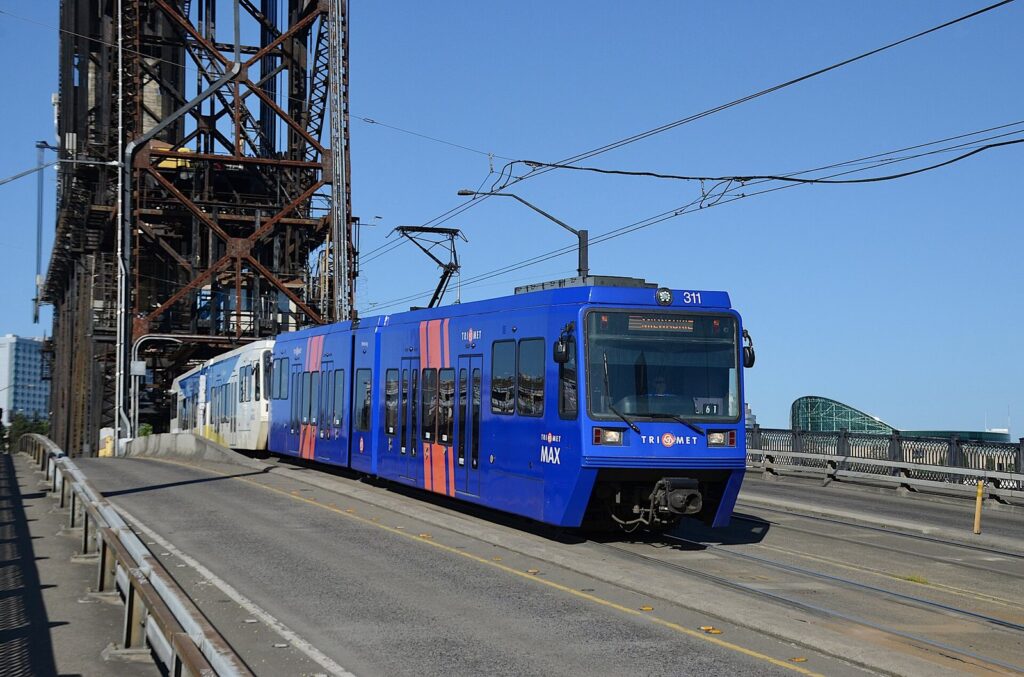
Getting around Portland, Oregon is easiest on TriMet’s network: the MAX Red Line runs from the airport to downtown in about 40 minutes, the Portland Streetcar and frequent buses cover the close-in neighborhoods, and one $2.80 fare buys 2.5 hours of rides, with charges capped at $5.60 a day when you tap the same card or phone. The central city is flat and made for walking, BIKETOWN e-bikes and shared scooters fill the gaps, and a car earns its keep only on day trips out of town.
This guide covers every way of moving around the city, from the step-by-step ride in from PDX to fares, bikes, parking and accessibility. The caveat worth knowing before you land: a few rides sit outside TriMet’s fare system (the Aerial Tram, the Columbia Gorge Express and the POINT coast bus each charge their own), and the West Hills are steep enough that walking to Pittock Mansion or the Japanese Garden is a workout. Fares, schedules and rules were checked September 24, 2026 against TriMet, the City of Portland, the Port of Portland and the operators’ own websites.
On this page: At a glance · From the airport · By train or bus · Fares · MAX lines · Streetcar · Buses · Walking · Bikes and scooters · Rideshare · Late nights · Rain, snow and heat · Driving and parking · Accessibility · Apps and habits · Getting to the sights · FAQ
How do you get around Portland?
Most visitors combine three things: MAX for longer hops, the streetcar or a bus for the close-in neighborhoods, and their feet for everything in between. Here’s how the options compare.
| Mode | Best for | Cost (2026) | Frequency and hours | Good to know |
|---|---|---|---|---|
| MAX light rail | The airport, downtown, Washington Park, the Lloyd District, the suburbs | $2.80 for 2.5 hours; capped at $5.60 a day | About every 15 minutes most of the day; first train from PDX 4:43 a.m., last 12:27 a.m. | Tap a phone or contactless card at the green reader |
| Portland Streetcar | The Pearl, NW 23rd, PSU, South Waterfront, the Central Eastside | Same TriMet fare | Seven days a week; live arrivals accurate to within 2 minutes | The NS Line plus the A and B Loops |
| Frequent buses | Hawthorne, Division, Alberta and other main streets | Same TriMet fare | Every 15 minutes or better most of the day; the FX2 every 12 | The only transit to many east side neighborhoods |
| Portland Aerial Tram | South Waterfront to OHSU on Marquam Hill | $9 round trip; free 6 and under with an adult | Weekdays 5:30 a.m.-9:30 p.m., Saturdays 9-5; no Sundays or holidays | Separate fare |
| BIKETOWN e-bikes | Short trips, the riverfront, bridges | $1 to unlock plus $0.35 a minute | Via the app | Lock at a station, or at a public rack for $1 more |
| Shared e-scooters | Short hops | Per-minute, by app | Via the Lime or Lyft app | 18 and over; no sidewalks |
| Walking | Downtown, the Pearl, Old Town, the waterfront | Free | Always | Short 200-foot blocks; steep West Hills |
| Rideshare and taxis | Late nights, hills, luggage | Varies | Always | At PDX, pickups are in the short-term garage |
| Rental car | Day trips to the Gorge, coast and mountain | Varies, plus parking | Always | Downtown meters about $3.40 an hour |
Verdict: skip the rental car for city days. A stay downtown, in the Pearl or near a MAX stop on the east side puts almost every city sight within one transit ride, and the daily fare cap means you never pay more than $5.60 for a day of rides.
How do you get from PDX to downtown Portland?
Portland International Airport’s new main terminal, under a nine-acre mass timber roof, began opening in August 2024, and getting into the city is simple. Here’s the MAX ride step by step:
- Find the MAX station. It sits at the west end of the terminal building, near baggage claim, with signs from the arrivals level.
- Tap to pay. Hold your phone (Apple Pay, Google Pay or Samsung Pay), a contactless credit or debit card, or a Hop card to the green reader on the platform before boarding. There’s no paper ticket to buy. An adult fare is $2.80 and covers 2.5 hours of rides, including transfers.
- Board any train. Only Red Line trains serve the airport, so every train on the platform heads toward downtown.
- Ride about 40 minutes. Trains run about every 15 minutes most of the day. The first train reaches the airport at 4:43 a.m., and the last one leaves for downtown and Beaverton at 12:27 a.m.
- Get off near your hotel. Key stops include Gateway Transit Center (transfers to the Blue and Green lines and the Gorge bus), Convention Center and Rose Quarter on the east side, then Old Town/Chinatown, Pioneer Square and Providence Park downtown.
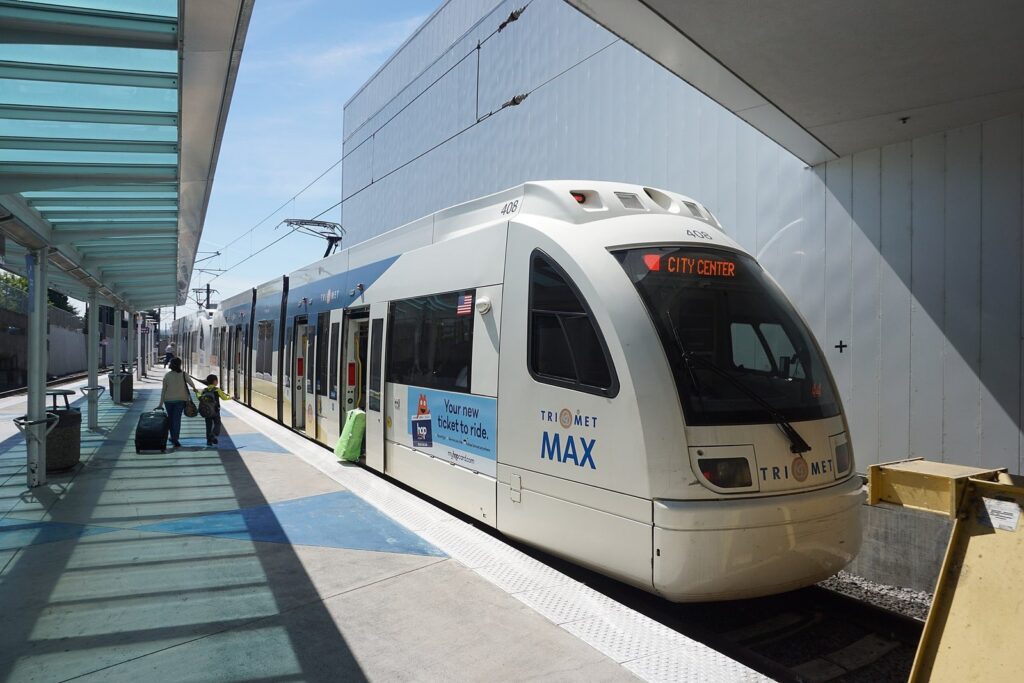
Rideshare and taxis: Uber, Lyft, Wingz and taxis no longer load at the terminal curb. Follow signs to the Transportation Plaza on Level 1 of the Short-Term Parking garage, where columns are labeled by provider. It’s the better option for large luggage, groups splitting a fare, late arrivals after the last train or hotels far from MAX.
Airport hotels: the hotels around Cascade Station, near the airport, sit on the Red Line, and many run their own shuttles. One more PDX detail: the airport’s shops and restaurants charge the same prices as their locations in town, so eating before a flight costs no more than eating downtown.
MAX, rideshare or hotel shuttle from PDX?
| Option | Cost | Time to downtown | Best for | Drawback |
|---|---|---|---|---|
| MAX Red Line | $2.80 adult; kids 6 and under free | About 40 minutes plus the wait | Solo travelers and couples with light bags; hotels near a station | No service between about 12:30 and 4:40 a.m. |
| Rideshare or taxi | Varies by time and demand | Depends on traffic | Groups, heavy luggage, late arrivals, hotels away from MAX | A walk to the garage; surge pricing at peak times |
| Airport hotel shuttle | Usually included with the room | Minutes to the hotel | Early flights and one-night stopovers | You’re still far from the city |
For most visitors the train wins: it avoids I-84 and I-205 traffic, costs the same at rush hour as at noon, and drops you in the middle of downtown. Take a rideshare if you land after the last train, travel as a group of three or more, or are staying somewhere MAX doesn’t reach.
Arriving by train or intercity bus
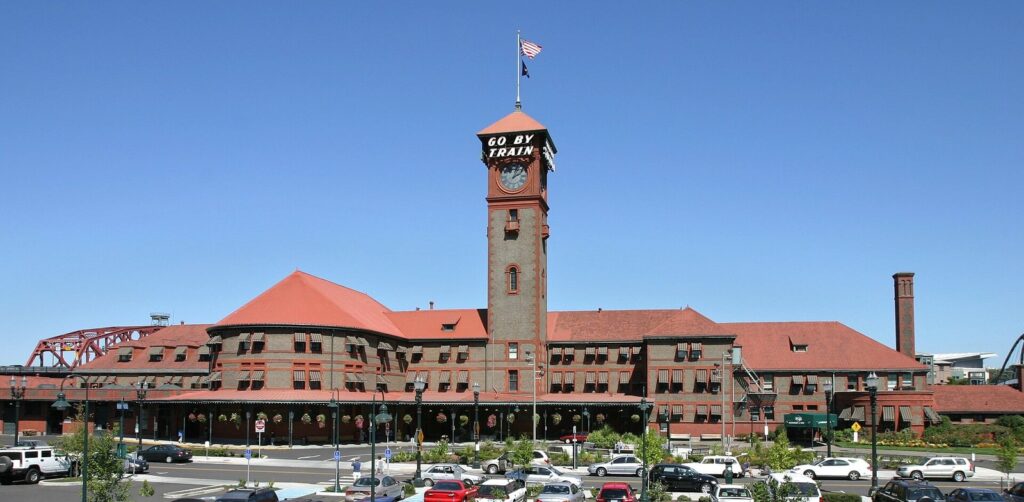
Amtrak trains arrive at Portland Union Station, 800 NW 6th Avenue, on the edge of Old Town and the Pearl District. It’s served by Amtrak Cascades (Eugene to Vancouver, British Columbia, via Portland and Seattle), the Coast Starlight (Los Angeles to Seattle) and the Empire Builder (from Chicago). MAX Green, Yellow and Orange line trains stop on the transit mall right beside the station, the streetcar runs a few blocks west, and the POINT NorthWest bus to Cannon Beach and Astoria also leaves from here, twice a day in each direction.
How do TriMet fares work?
One fare covers MAX, TriMet buses and the Portland Streetcar, and the system rewards you for tapping the same card or phone every time:
| Fare type | Per ride (2.5 hours) | Daily cap | Monthly cap | Who qualifies |
|---|---|---|---|---|
| Adult | $2.80 | $5.60 | $100 | Ages 18 to 64 |
| Honored Citizen | $1.40 | $2.80 | $28 | Riders 65 and older, riders with disabilities and some others |
| Youth | $1.40 | $2.80 | $28 | Ages 7 to 17; proof of age may be requested for 15 to 17 |
| Children | Free | Free | Free | 6 and under, with a paying passenger |
How to pay: tap a contactless bank card or a phone or watch wallet at the green Hop reader on MAX platforms or as you board a bus or streetcar. Each tap covers 2.5 hours of unlimited transfers, and once your taps for the day reach the cap, the rest of the day’s rides are free. Youth and Honored Citizen riders should use a Hop card or virtual card set to their fare type, sold at grocery stores and station machines or added to a phone wallet, so the lower fare and caps apply. Use one card per person; a group can’t share a tap.
Not included: the Aerial Tram ($9 round trip), the Columbia Gorge Express to Multnomah Falls and Hood River and the POINT coast bus each sell their own tickets.
A day of fares, in practice
Here’s how the caps play out on a typical sightseeing day. Tap at 9:15 a.m. for MAX to Washington Park: $2.80, good until 11:45. Tap again at 1:45 p.m. for the streetcar into the Pearl: another $2.80, which reaches the $5.60 daily cap. Every ride after that, including the bus to dinner on Hawthorne and back to your hotel, costs nothing. A family of two adults with children aged 9 and 5 pays at most $14 for the whole day: $5.60 for each adult, $2.80 for the 9-year-old on a Youth card and nothing for the 5-year-old.
The caps reset each day, and they count only taps on the same card or phone, so don’t switch between your phone and a physical card midweek. For a stay of a week or more, the $100 monthly cap rarely comes into play; the daily cap does the work.
Which MAX line goes where?
MAX has five lines, and all of them run through downtown. For visitors, the useful part of each line is short.
| Line | Route | Useful stops for visitors |
|---|---|---|
| Red | PDX airport to Beaverton via Gateway, the Lloyd District and downtown | PDX, Convention Center, Rose Quarter, Old Town, Pioneer Square, Providence Park, Washington Park (the zoo) |
| Blue | Gresham to Hillsboro via Gateway, the Lloyd District and downtown | Hollywood, Lloyd Center, Rose Quarter, Old Town, Pioneer Square, Washington Park |
| Green | Clackamas Town Center to Portland State via Gateway and the transit mall | Lloyd District, Union Station, the transit mall, PSU |
| Yellow | Expo Center to Portland State via N Interstate Avenue and the transit mall | Albina/Mississippi (for Mississippi Avenue), Kenton, Union Station, the transit mall |
| Orange | Downtown to Milwaukie via South Waterfront and Tilikum Crossing | South Waterfront, OMSI/SE Water, Clinton/SE 12th, SE Tacoma/Johnson Creek (for Sellwood) |
Washington Park station, on the Red and Blue lines, deserves a mention of its own: its platform sits 260 feet underground, the deepest transit station in North America, and elevators carry you to the surface next to the Oregon Zoo, where the park’s free shuttle boards.
How does the Portland Streetcar work?
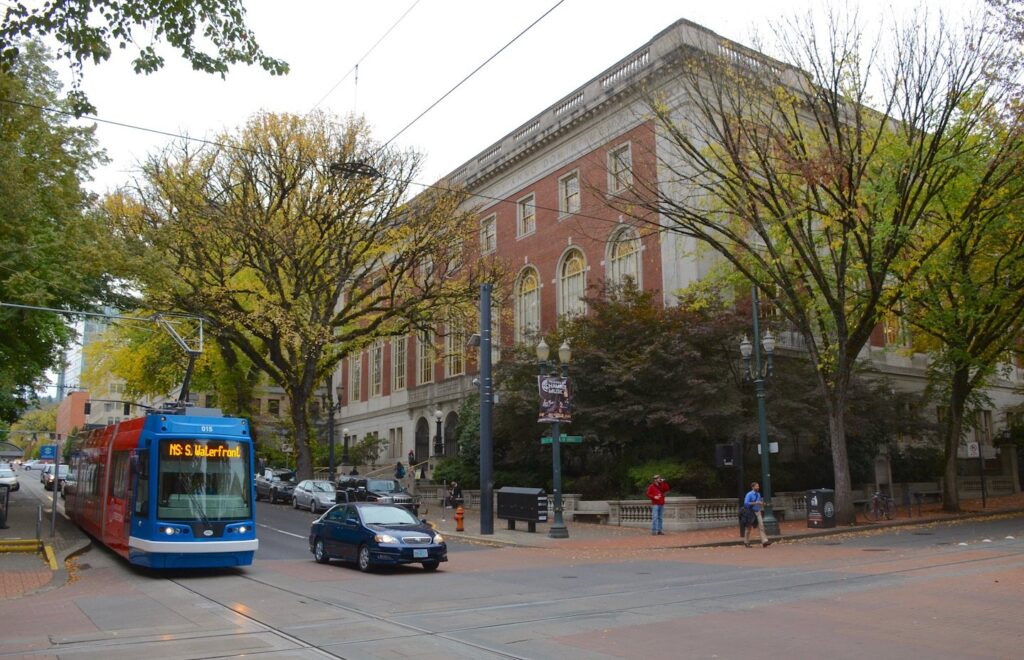
The streetcar is the easiest way to link the Pearl District, Nob Hill and the Central Eastside, and it takes the same TriMet fare. It runs seven days a week on three routes:
- The NS Line runs north-south from NW 23rd Avenue and Marshall Street through Nob Hill, the Pearl District, downtown and Portland State University to South Waterfront, where the Aerial Tram boards.
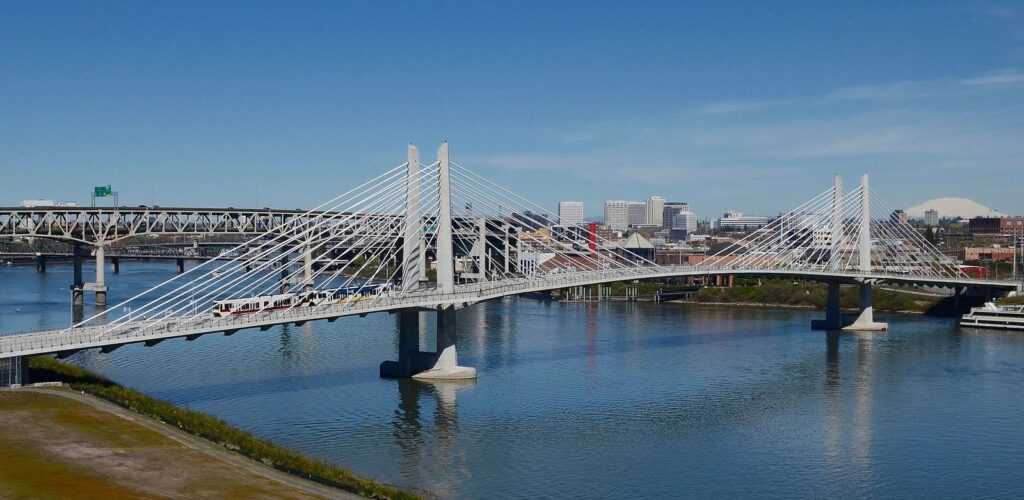
- The A Loop and B Loop circle the central city in opposite directions, crossing the Broadway Bridge and the car-free Tilikum Crossing, and serving the Pearl, the Lloyd District and Convention Center, the Central Eastside, OMSI, South Waterfront and PSU.
Arrival predictions, posted online, are accurate to within about two minutes. The loops are also a cheap sightseeing ride: one trip around shows you both bridges, the east bank’s warehouses and the Pearl.
Which Portland buses are worth knowing?
TriMet’s Frequent Service lines run every 15 minutes or better most of the day, every day, and they’re the way to reach the east side’s main streets. Three stand out for visitors:
- Line 14-Hawthorne/Foster runs from downtown over the Hawthorne Bridge and along Hawthorne and Madison, then Foster Road to Lents, every 15 minutes or less for most of the day. It serves Cartopia, Hawthorne Asylum, the Hawthorne shops and the Portland Mercado.
- FX2-Division, TriMet’s high-capacity bus, runs along Division Street every 12 minutes for most of the day, every day, past the east side’s densest restaurant strip and near Mount Tabor.
- Line 72-Killingsworth/82nd runs a few blocks north of Alberta Street, the easiest way to reach the Alberta Arts District.
Other frequent lines follow Burnside (Line 20) and Sandy Boulevard (Line 12). TriMet adjusts service several times a year; its August 23, 2026 changes, for example, reworked commute-time buses between Sauvie Island, St. Johns and NW 44th and Yeon. Use TriMet’s trip planner or a transit app for live times.
Is Portland a walkable city?
Very, in the center. Downtown’s blocks are small, 200 feet on a side, the ground is flat from the river to the West Hills, and Oregon law treats every intersection as a crosswalk, so drivers generally stop for people on foot. Downtown, Old Town, the Pearl, the waterfront and the Central Eastside are all comfortable to walk, and addresses make navigation easy: drop the last two digits of an east-west street number and you have the nearest avenue, so 1207 SE Hawthorne Boulevard is at SE 12th.
The bridges are part of the walking city. The Hawthorne Bridge, Tilikum Crossing, the Broadway Bridge and the Steel Bridge’s lower deck all carry people on foot across the Willamette, and the loop along Tom McCall Waterfront Park and the Eastbank Esplanade is the city’s classic stroll. The West Hills are the exception: Washington Park, Pittock Mansion and Forest Park sit on steep slopes, so let MAX and the park shuttle do the climbing.
Biking and scooters in Portland
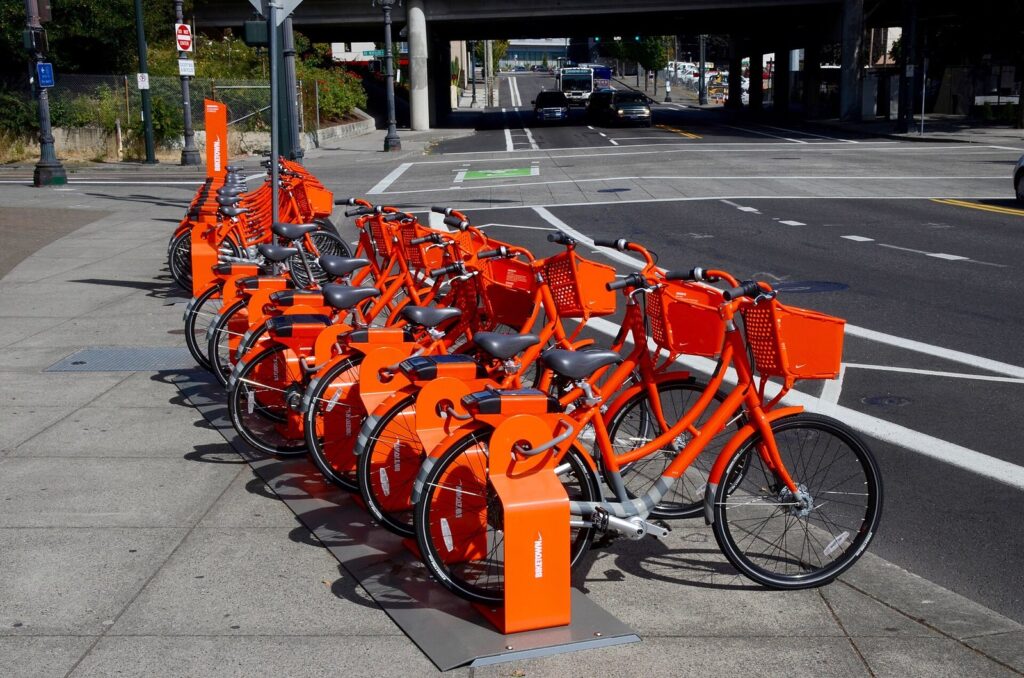
Portland is one of the country’s most bike-friendly cities, with bike lanes on many main streets, quiet neighborhood greenways on side streets and car-free bridges. For visitors, the easy option is BIKETOWN, the city’s bike share, now all e-bikes:
- Pay as you go: $1 to unlock plus $0.35 a minute, through the BIKETOWN or Lyft app.
- Annual membership: $99 a year, with free unlocks and $0.15 a minute, which pays off only for long stays.
- Parking: lock at any BIKETOWN station for free, or at any public bike rack in the service area for $1 more.
Shared e-scooters from Lime and Lyft are part of a permanent city program that launched in 2024, with the fleet allowed to grow to 4,300 scooters in 2026. The rules are strict and enforced: you must be 18 to ride a shared scooter, riding on sidewalks and in crosswalks is prohibited, one rider per scooter, yield to pedestrians, and scooters aren’t allowed in parks except on park roads and in parking areas. After each ride, lock the scooter to a bike rack or sign.
Bikes are welcome on MAX, and the car-free Tilikum Crossing and the Eastbank Esplanade make a flat, scenic ride between OMSI, the waterfront and downtown.
Rideshare and taxis
Uber, Lyft and taxis work throughout the city and earn their fare in a few situations: late at night after the trains thin out, trips up into the West Hills to Pittock Mansion, groups splitting one fare, and heavy luggage. At the airport, all of them pick up on Level 1 of the Short-Term Parking garage. Most rideshares don’t provide child car seats, which Oregon law requires for young children, so families should bring their own or stick to transit.
Getting around late at night
MAX runs until after midnight, but service thins in the late evening, and the airport’s last train leaves at 12:27 a.m. Frequent bus lines keep running later than infrequent ones but at longer intervals after about 9 p.m., so check live arrivals before leaving a restaurant rather than walking to a stop and waiting. Your 2.5-hour fare window still applies, and the daily cap resets overnight. For trips after the trains stop, or back to a hotel on a quiet block, a rideshare is the simplest option. Downtown, the Pearl, Hawthorne, Division, Alberta and Mississippi stay busy into the evening and are the most comfortable streets to walk at night.
Getting around in rain, snow and heat
Rain is normal and rarely affects transit; a hooded rain shell handles it. Snow and ice are rare, averaging 4.2 inches of snow a year, but when they arrive the city struggles: hills become impassable for cars, buses switch to snow routes, and MAX can slow or pause while crews clear switches and overhead wires. On those days, check TriMet’s service alerts before setting out, allow extra time and favor MAX over buses on hilly routes. Extreme summer heat can slow trains too, as happened during the June 2021 heat wave, when the airport reached a record 116°F. On hot afternoons, plan short hops and ride in the morning or evening.
Do you need a car in Portland?
Not for the city. Downtown hotels charge for parking nightly, meters are busy, and transit covers the sights. A car makes sense for day trips to the Columbia River Gorge beyond Multnomah Falls, the coast, Mount Hood and wine country, and for travelers staying in outer neighborhoods. Rent one for those days only.
If you do drive in the city, here’s what parking costs:
- Street meters: rates in the Downtown, Central Eastside and Northwest districts rose 20 cents an hour on July 1, 2026, which put downtown (including the Pearl and South Waterfront) at about $3.40 an hour, plus small per-transaction fees. Pay at the meter, by text or with the Parking Kitty app, and read the posted hours and time limits on each block.
- City garages: the city’s five SmartPark garages downtown sell hourly and all-day parking; their rates also rose on July 1, 2026, by 15 cents an hour and $1 for the weekday all-day rate.
- Washington Park: $2.40 an hour or $9.60 a day, enforced 9:30 a.m. to 8 p.m. daily.
- Hotels: most downtown hotels charge a nightly parking fee; check it before you book.
Two more driving notes. In the Portland area, gas stations may offer self-serve at up to half their pumps, at the same price as the attended ones, while in rural counties such as Hood River and Clatsop you can pump your own anywhere, anytime. And on day trips, remember the permits: Oregon State Parks day-use parking ($10 a day for residents, $12 for visitors) and Sno-Park permits on Mount Hood from November 1 to April 30.
Getting around Portland with a disability
MAX trains, buses and streetcars are wheelchair-accessible, and the central city is flat, with curb ramps at most corners. Riders with disabilities qualify for TriMet’s Honored Citizen fare, $1.40 a ride with a $2.80 daily cap, using a Hop card set to that fare type. TriMet’s LIFT paratransit serves people who can’t use regular service, and under federal rules, visitors certified for paratransit at home can request service during a stay; contact TriMet ahead of your trip. In Washington Park, elevators connect the deep MAX platform to the surface, and the free shuttle stops at each major attraction. The West Hills’ trails and some garden paths are steep; call attractions ahead to ask about step-free routes and wheelchair loans.
Apps and habits that make it easier
- Plan trips with TriMet’s trip planner or a mapping app that uses its live data; both show MAX, bus and streetcar times together.
- Tap every time you board, even within your 2.5-hour window, so the system can track your caps and the fare inspectors can see a valid fare.
- Keep BIKETOWN, Lime or Lyft, and Parking Kitty on your phone if you plan to ride or drive; each is how you pay.
- Use the right door and seat. Priority seating near the front of trains and buses is for older riders and people with disabilities, and bikes go in the marked spaces on MAX.
- Watch the destination sign, not just the color. Several lines share tracks downtown, so confirm the train’s final stop before boarding.
How to get to Portland’s main sights
| Destination | Easiest way from downtown | Allow |
|---|---|---|
| Oregon Zoo and Washington Park | MAX Red or Blue to Washington Park, then the free shuttle for the gardens | 25-35 minutes to the station plaza |
| Portland Japanese Garden and Rose Garden | MAX to Washington Park plus the shuttle (every 30 minutes, 10-4, October-March), or a rideshare | 35-55 minutes by transit |
| Powell’s, Lan Su and Old Town | Walk, or the streetcar and MAX | 10-20 minutes |
| OMSI | MAX Orange Line or the streetcar loops to OMSI/SE Water | 15-20 minutes |
| Aerial Tram | Streetcar NS Line to South Waterfront | 20-30 minutes |
| Hawthorne and Cartopia | Line 14, or walk over the Hawthorne Bridge | 15 minutes by bus, about 25 on foot |
| Division Street | FX2 bus | 15-25 minutes |
| Alberta Arts District | Line 72 or other buses | 30-40 minutes |
| Mississippi Avenue | MAX Yellow to Albina/Mississippi | 20-25 minutes |
| Pittock Mansion | Rideshare, or a bus and a steep walk | 15 minutes by car |
| Multnomah Falls | MAX to Gateway, then the Columbia Gorge Express | Plan a half day or more |
For how these fit into full days, see our Portland itineraries, which include transit legs and time budgets, and our neighborhoods guide, which maps which lines reach each district. Choosing a base near MAX makes all of this easier; our guide to where to stay in Portland compares areas by transit access.
Getting Around Portland, Oregon FAQ
Do you need a car in Portland, Oregon?
Not for the city. MAX, the streetcar and frequent buses reach the airport, downtown, Washington Park and the main east side neighborhoods, and the daily fare cap keeps a full day of rides at $5.60. Rent a car only for day trips to the coast, Mount Hood or wine country, and skip it for the Gorge if Multnomah Falls and Hood River are enough, since a bus goes there.
How do I get from PDX to downtown Portland?
Take the MAX Red Line from the station at the west end of the terminal, near baggage claim. Tap a phone or contactless card at the green reader ($2.80), board any train and ride about 40 minutes to downtown. Trains run about every 15 minutes most of the day, from a first arrival at 4:43 a.m. to a last departure at 12:27 a.m.
Can I pay for TriMet with my phone?
Yes. Tap Apple Pay, Google Pay or Samsung Pay, or a contactless credit or debit card, on the green Hop reader. Each tap covers 2.5 hours, and using the same card or phone each time caps your spending at $5.60 a day and $100 a month. Each rider needs their own card or phone; one tap covers one person.
Does the Portland Streetcar cost extra?
No. The streetcar takes the standard TriMet fare, so a tap on MAX or a bus covers it within your 2.5-hour window, and it counts toward the daily cap. The Aerial Tram is the exception among the city’s rides: it charges its own $9 round-trip fare and doesn’t run on Sundays or holidays.
How late does MAX run in Portland?
MAX runs from early morning until after midnight, with trains every 15 minutes or so for most of the day and less often late at night. On the Red Line, the first train reaches the airport at 4:43 a.m., and the last train leaves the airport for downtown and Beaverton at 12:27 a.m. Check TriMet’s trip planner for exact late-night times on other lines.
Is Portland public transit safe?
Most of TriMet’s millions of rides a year are uneventful, and trains and buses are busiest, and most comfortable, during the day and early evening. As in any big city, stay aware on platforms late at night, keep valuables out of sight and move to another car or sit near the operator if something makes you uneasy. TriMet posts safety staff and security on the system.
Can I ride a scooter or bike on the sidewalk in Portland?
Not a shared e-scooter: Portland prohibits scooter riding on sidewalks and in crosswalks, and riders must be 18 or older. Use streets, bike lanes and multi-use paths, and lock the scooter to a bike rack or sign when you’re done. For bikes, stick to bike lanes and greenways; downtown sidewalks are for people on foot.
Related Portland Guides
- Portland, Oregon Travel Guide: the trip-planning basics, from seasons to costs.
- Portland, Oregon Itinerary: day plans with transit legs and time budgets.
- Where to Stay in Portland, Oregon: bases compared by transit, noise and parking.
- Day Trips from Portland, Oregon: getting to the Gorge, coast and mountain, by car or bus.
- Portland, Oregon with Kids: family transit tips, from free fares under 7 to strollers.
Sources and verification
Fares, schedules, rules and rates on this page were checked on September 24, 2026 against the agencies and operators listed below. The guide is compiled from those sources and claims no first-hand trips.
- TriMet: fares
- TriMet: Youth fares
- TriMet: how to take MAX to and from PDX
- TriMet: Frequent Service lines
- TriMet: August 2026 service changes
- Portland Streetcar
- Portland Aerial Tram: fares and hours
- Port of Portland: PDX rideshares and taxis
- BIKETOWN: pricing
- City of Portland: e-scooter rules
- City of Portland: parking meter rates
- City of Portland: SmartPark garages
- Explore Washington Park: free shuttle
- Amtrak: Portland Union Station
- POINT: NorthWest bus
- Columbia Gorge Express
- Oregon State Fire Marshal: self-serve fueling
Portland Tourism Guide is an independent publication, not affiliated with Travel Portland, the City of Portland or any business named here.
Photo credits
- MAX train on the Steel Bridge: photo by Steve Morgan, Wikimedia Commons (CC BY-SA 4.0)
- MAX at Portland International Airport station: photo by Michael Barera, Wikimedia Commons (CC BY-SA 4.0)
- Portland Union Station: photo by Cacophony, Wikimedia Commons (CC BY-SA 2.5)
- Portland Streetcar at Central Library: photo by Steve Morgan, Wikimedia Commons (CC BY-SA 4.0)
- Tilikum Crossing: photo by Steve Morgan, Wikimedia Commons (CC BY-SA 4.0)
- BIKETOWN station: photo by Steve Morgan, Wikimedia Commons (CC BY-SA 4.0)