The Portland, Oregon itinerary that suits most first visits runs three days: one on the west side for Washington Park’s gardens, Powell’s and Old Town; one on the east side for the river, the food carts and a sunset from Mount Tabor; and one out of town in the Columbia River Gorge. With a single day, do the west side. With a fourth, add the coast, Mount Hood or the Willamette Valley. Each plan below is timed door to door, with the transit leg, the meal stop and a rain swap written in.
The plans work for first-timers and repeat visitors, with or without a car. The caveat that matters most is the calendar: Portland’s big sights close on different days of the week, so the order of your days matters more than the list. The Japanese Garden is closed on Tuesdays, the art museum and OMSI on Mondays, and the Aerial Tram doesn’t run on Sundays. Hours, fares and prices were checked September 24, 2026 against the operators’ and agencies’ own websites.
On this page: How many days · Closed days · One day · Two days · Three days · Four days or more · Without a car · Rain · By season · Costs · FAQ
How many days do you need in Portland?
Three days is the sweet spot: two in the city and one out of it. Two days covers the city at a humane pace. One day covers the west side and a look at the river, and five to seven days lets you add the coast or Mount Hood and still leave a morning with nothing in it. If you’re still deciding what to see rather than when, start with our list of things to do in Portland, Oregon. This page is about order, timing and the legs in between.
| Trip length | What it covers | Car? | Admissions per adult (2026) | Book ahead | If it rains |
|---|---|---|---|---|---|
| 1 day | Washington Park, NW 23rd, Powell’s, Lan Su, the waterfront, a food cart dinner | No | $40.50 (Japanese Garden, Lan Su) | Japanese Garden tickets, up to 10 days out | Trade the waterfront walk for the art museum |
| 2 days | Day one, plus the Aerial Tram, Tilikum Crossing, OMSI, the Eastbank Esplanade, Hawthorne, Division and Mount Tabor | No | About $72 (adds the tram and OMSI) | Nothing essential | Stretch OMSI; drop the Tabor sunset |
| 3 days | Days one and two, plus the Gorge: Crown Point, the old-highway waterfalls, Multnomah Falls, Hood River | Easier with one; a bus covers Multnomah Falls and Hood River | No entry fees at the stops named; budget fuel or bus fare | Multnomah Falls timed-entry permit in season (2026: May 22-Sept. 7) | Go anyway: the falls run heavier in the wet months |
| 4 days | Add the coast, Mount Hood or wine country | Yes | Varies | Tasting appointments; winter traction gear for Mount Hood | Choose the day trip after checking the forecast |
| 5-7 days | Add Forest Park, Pittock Mansion, North Portland, Alberta, Sellwood and a night away | For the day trips | Add $17 for Pittock, $27.50 for the art museum | Weekend dinners | Save museum days for the wettest forecasts |
Verdict: if you can add only one day to a two-day city visit, give it to the Gorge. The first waterfalls are about half an hour from downtown, and of all the out-of-town days it’s the easiest to do by bus.
Every plan assumes a base downtown, in the Pearl District or on the close-in east side, where MAX, the streetcar or a flat walk reaches each day’s first stop. For the groundwork (when to go, getting in from PDX, what hotel taxes add), see our Portland trip-planning guide.
Which days are Portland attractions closed?
Most itineraries online read as if every sight opens every day. Portland’s don’t, and the gaps fall on different weekdays. Before you slot anything, write down which weekday each trip day lands on and check it against this table.
| Day | Closed or limited | Good day for |
|---|---|---|
| Monday | Portland Art Museum closed; OMSI closed (a few holiday Mondays excepted) | Washington Park, Lan Su, Forest Park, Pittock Mansion |
| Tuesday | Portland Japanese Garden closed; Pittock Mansion’s house closes at noon (September 2026 hours) | The east side, the art museum, OMSI, the Aerial Tram |
| Wednesday to Friday | Nothing major closed; the art museum is free 10 a.m.-7 p.m. on the first Thursday of each month | Your west-side garden day |
| Saturday | The Aerial Tram runs only 9 a.m.-5 p.m. | Portland Saturday Market (10 a.m.-5 p.m., through December 19, 2026) and the PSU Farmers Market at SW Park and Montgomery (8:30 a.m.-2 p.m. through October, from 9 a.m. in winter) |
| Sunday | No Aerial Tram; no Saturday Market | Gardens, the Esplanade, a Gorge day |
A few dated closures catch people too: the Oregon Zoo closes October 1, Thanksgiving (November 26, 2026) and Christmas Day, and opens only Friday through Monday from December 1 to 17. The tram also stops for holidays, and the Washington Park shuttle skips bad-weather days, Thanksgiving and Christmas.
How to order your days: arrive on a Monday and spend it on the west side, where the gardens are open and the museums aren’t. Arrive on a Tuesday and flip the plan: the east side and OMSI first, the Japanese Garden on Wednesday. The Gorge fits any day. Midweek is quieter at Multnomah Falls, and a Sunday, when the tram isn’t running anyway, is a good day to be out of town. Whatever the order, keep each day on one side of the river: three crossings a day can eat an hour.
One day in Portland: the west side, timed
With one day, stay west of the Willamette and let MAX do the climbing. The plan starts at Washington Park when the Japanese Garden opens, walks downhill to NW 23rd Avenue for lunch, rides the streetcar into the Pearl District and works east through Old Town to the river, finishing with dinner on the far bank. You’ll walk roughly three to four miles, most of it flat or downhill.
| Time | Stop | Getting there | Allow |
|---|---|---|---|
| 9:15 a.m. | Leave downtown | MAX Red or Blue Line west to Washington Park station, then the elevator up | 25-35 min door to door |
| 9:45 a.m. | Free Shuttle Loop | Boards at the plaza outside the elevators | Up to a 15-min wait (30 from October to March) |
| 10:00 a.m. | Portland Japanese Garden | Shuttle to the garden’s stop | 90 min |
| 11:30 a.m. | International Rose Test Garden | A few minutes on foot, across SW Kingston Ave | 30-45 min |
| 12:15 p.m. | Walk to Northwest | Downhill through the park’s lower entrance to W Burnside | 25-30 min |
| 12:45 p.m. | Lunch on NW 23rd Avenue | On foot | 60 min |
| 1:45 p.m. | Streetcar to the Pearl | NS Line from NW 23rd and Marshall | 15-20 min |
| 2:05 p.m. | Powell’s City of Books | A short walk from the streetcar | 60-90 min |
| 3:35 p.m. | Lan Su Chinese Garden | Walk east to NW 3rd and Everett | 15-min walk, 60 min inside (last entry 5 p.m.) |
| 4:50 p.m. | Waterfront Park and Mill Ends Park | Walk to the river, then south along the seawall | 40 min |
| 5:30 p.m. | Hawthorne Bridge | Across on foot, then east on Hawthorne to SE 12th | 25-30 min |
| 6:00 p.m. | Dinner at Cartopia | SE 12th and Hawthorne | 60 min, then a bus back downtown |
Morning: Washington Park
MAX Red and Blue Line trains leave downtown for Washington Park station about every 15 minutes. The platform sits 260 feet underground, the deepest transit station in North America, and elevators lift you to the plaza where the park’s free shuttle boards. It runs 9:30 a.m. to 7 p.m. every 15 minutes from April through September, and 10 a.m. to 4 p.m. every 30 minutes from October through March, stopping at every major attraction.
That winter schedule is the snag in a 10 a.m. start: the first loop leaves at 10, so you reach the Japanese Garden around 10:15 or later. If being first through the gate matters, take a rideshare. Drivers pay $2.40 an hour or $9.60 a day to park, enforced 9:30 a.m. to 8 p.m. daily through the ParkingKitty app or kiosks.
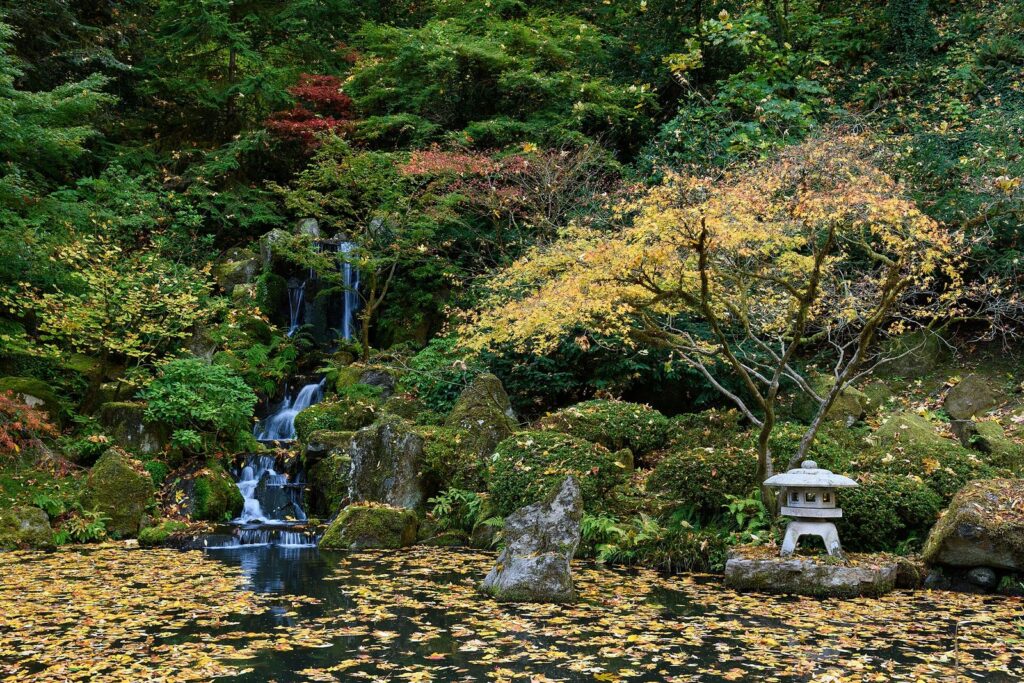
The Portland Japanese Garden opens 10 a.m. to 5:30 p.m., Wednesday through Monday. Adults pay $22.50, with discounts for seniors, students and ages 6-17, and tickets can be booked up to 10 days ahead. Give it 90 minutes. It’s at its best in fall color and in light rain, which is lucky, given the city. The International Rose Test Garden is a few minutes away across SW Kingston Avenue. It’s free, open 5 a.m. to 10 p.m., and holds more than 10,000 bushes of over 610 varieties that bloom from late May into October. Out of season it’s a set of terraced lawns with a downtown view, worth 15 minutes rather than 45.
Think twice if it’s a Tuesday. The Japanese Garden is closed, so ride the shuttle to Hoyt Arboretum instead: it’s free, open year-round and holds more than 2,300 species, with some paved trails among the dirt ones. Or simply swap days one and two.
Midday: NW 23rd and the Pearl
From the Rose Garden, walk downhill out of the park’s lower entrance and across W Burnside into Northwest. NW 23rd Avenue, between Burnside and Thurman, is the main street of Nob Hill: old houses turned into shops, cafes and restaurants, with enough choice that lunch needs no plan. Afterward, catch the Portland Streetcar’s NS Line, which starts at NW 23rd and Marshall, and ride it east into the Pearl District.
Fare math: your 9:15 MAX tap covered 2.5 hours and has lapsed. Tapping the same card or phone again costs $2.80 and hits the $5.60 daily cap, so every later ride today is free.
Afternoon: Powell’s and Lan Su
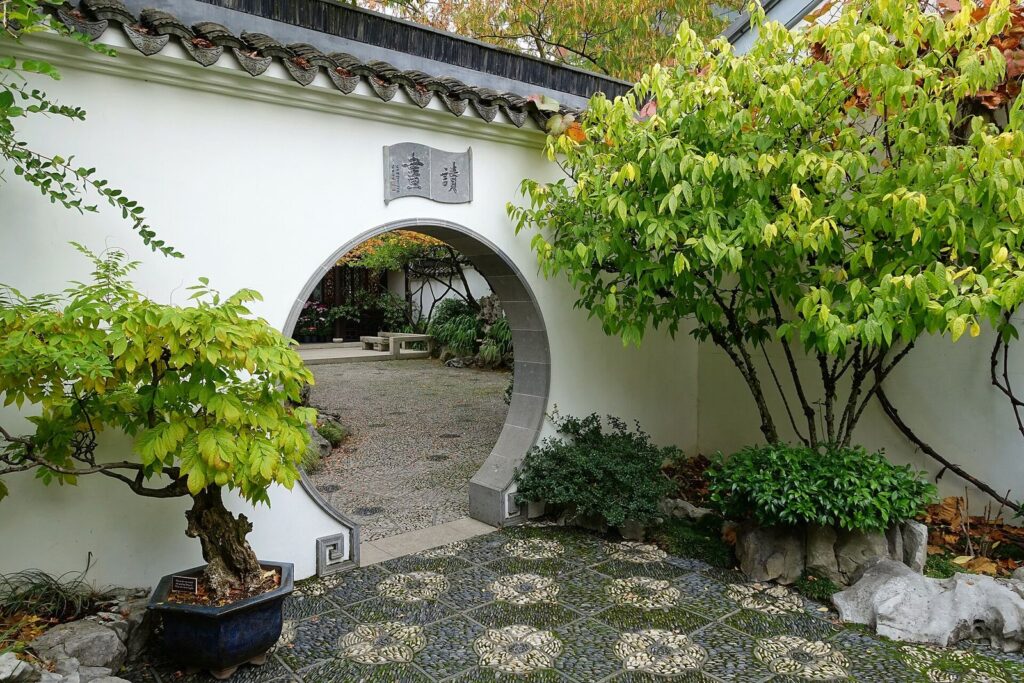
Powell’s City of Books fills a city block on W Burnside with new and used books in color-coded rooms. An hour disappears easily, and 90 minutes is normal. Then walk east about 15 minutes to Lan Su Chinese Garden at 239 NW Everett St, in Old Town Chinatown. It’s open daily 10 a.m. to 5:30 p.m. with last entry at 5, and adults pay $18. The teahouse inside, Yun Shui, is a fine place to sit out a wet afternoon, and the garden itself takes about an hour at a slow walk.
Evening: the river and dinner on the east side
From Lan Su it’s a few blocks to Tom McCall Waterfront Park. Walk south along the seawall, past the Saturday Market’s home by the Burnside Bridge, to Mill Ends Park in the median of SW Naito Parkway at Taylor Street. It’s two feet across, Guinness has listed it as the world’s smallest park since 1971, and seeing it takes about as long as reading this sentence. Carry on to the Hawthorne Bridge, cross on the sidewalk and follow Hawthorne Boulevard east to Cartopia at SE 12th Avenue, 25 to 30 minutes from Mill Ends on foot.
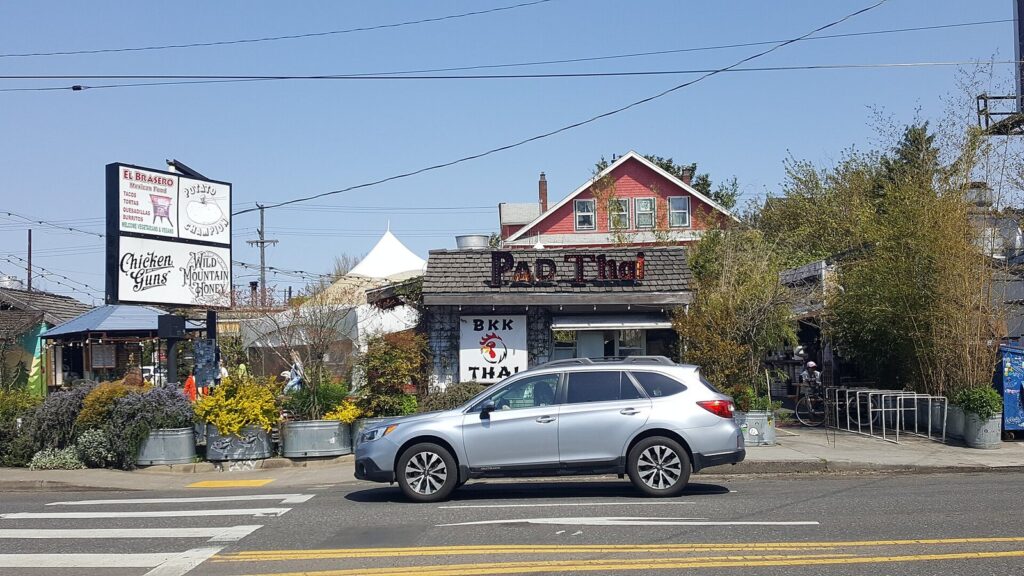
Cartopia had seven carts in September 2026 and stays open until 10 p.m. Monday through Wednesday, 11 p.m. on Thursdays and Sundays, and midnight on Fridays and Saturdays. Buses run back along Hawthorne to downtown when you’re done, and your fare cap already covers them.
Verdict: if you cut everything else, keep this day. It gives you the gardens, the bookstore, the river and a food cart dinner without a single parking decision.
Two days in Portland: add the river and the east side
Day two crosses the Willamette once, early, and then stays east. It’s built around one ride (the Aerial Tram), one walk (Tilikum Crossing and the Eastbank Esplanade), one optional museum (OMSI) and an evening on Division Street and Mount Tabor. Apart from the tram, nothing costs money unless you choose OMSI.
| Time | Stop | Getting there | Allow |
|---|---|---|---|
| 9:00 a.m. | South Waterfront | Streetcar NS Line from downtown or the Pearl to the lower tram terminal | 20-30 min |
| 9:30 a.m. | Portland Aerial Tram | Up to OHSU and back; $9 round trip | 45 min with the view |
| 10:15 a.m. | Tilikum Crossing | Walk north along the river, then over the bridge | 25 min |
| 10:45 a.m. | OMSI (optional) | At the bridge’s east end | 2 hours |
| 12:45 p.m. | Eastbank Esplanade | Walk north along the river | 30-45 min |
| 1:30 p.m. | Lunch in the Central Eastside | A few blocks inland from the path | 60 min |
| 2:45 p.m. | Hawthorne Boulevard, SE 30th to 50th | TriMet bus or rideshare | 90 min |
| 4:30 p.m. | Division Street | Walk 10-15 min south | Browse, then an early dinner |
| Sunset | Mount Tabor summit | Bus or rideshare east, then the walk up | 45 min |
Morning: the Aerial Tram and Tilikum Crossing
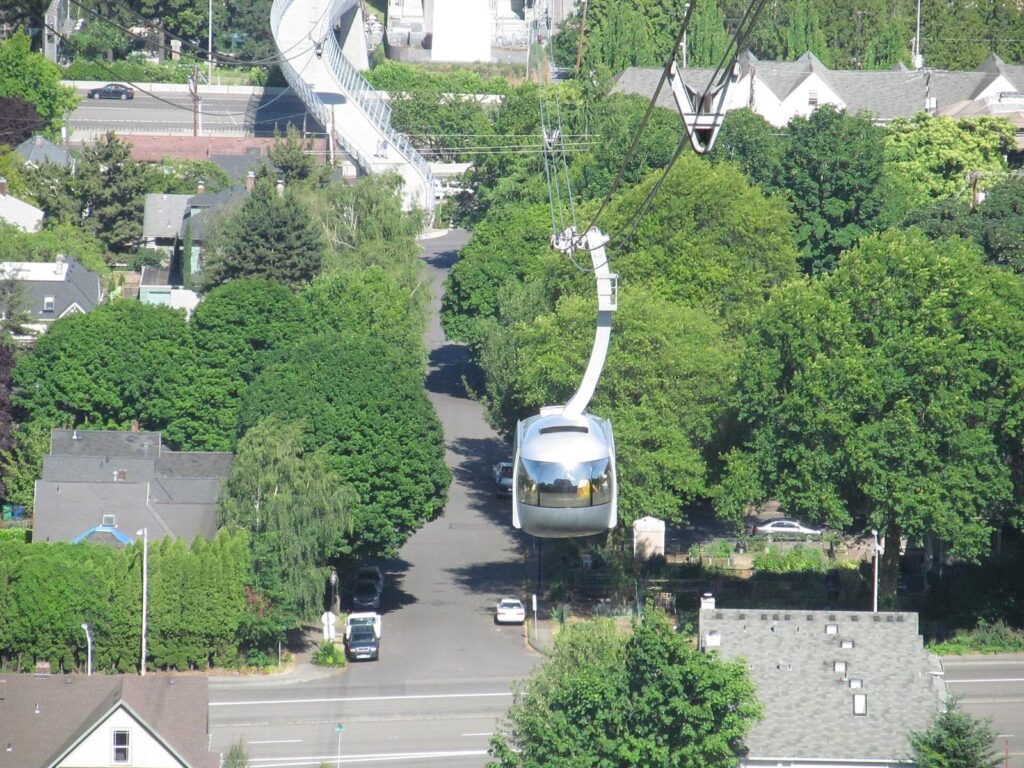
The Portland Aerial Tram climbs 500 feet over 3,300 feet of cable, from its lower terminal at 3303 S Bond Ave in South Waterfront to Oregon Health & Science University on Marquam Hill. A round trip costs $9, valid on the day you buy it, and children 6 and under ride free with a paying adult. It runs weekdays 5:30 a.m. to 9:30 p.m. and Saturdays 9 a.m. to 5 p.m., and not at all on Sundays or holidays. Ride up, look east over the river toward the Cascades, and ride back down; the tram was built for hospital commuters, and there’s little else up top for visitors.
From the lower terminal, walk north along the river to Tilikum Crossing, the bridge that carries MAX, buses, the streetcar, bikes and people on foot but no private cars. Its east end lands beside OMSI. Allow about 25 minutes, more if you stop mid-span for the downtown skyline, which is the best free view of the day.
Late morning: OMSI or the Esplanade
The Oregon Museum of Science and Industry opens 9:30 a.m. to 5:30 p.m. Tuesday through Friday and on Sundays, and until 7 p.m. on Saturdays, on its schedule from September 8, 2026 to June 13, 2027. It’s closed on Mondays, with a few exceptions. Adults pay $22.50 and ages 3-13 $15.50; the planetarium, submarine tour and theater cost extra. Give it two hours, or three with children. OMSI has its own MAX and streetcar stop, OMSI/SE Water, if you want to break the walk.
If science museums aren’t your thing, skip OMSI and walk north on the Vera Katz Eastbank Esplanade, a 1.5-mile path from the Hawthorne Bridge to the Steel Bridge that includes a 1,200-foot floating walkway, the longest of its kind in the country. Leave it near the Burnside Bridge and walk a few blocks inland into the Central Eastside, the old warehouse district, where breweries, coffee roasters and lunch counters now fill the loading docks.
Afternoon: Hawthorne and Division
Take a bus or a rideshare out Hawthorne Boulevard to the shopping stretch between about SE 30th and SE 50th, where vintage clothing, records, used books and coffee fill old storefronts. Then walk south to Division Street, where restaurants line block after block through the 20s and 30s. Pick dinner by reading menus in windows; it’s that kind of street.
Evening: Mount Tabor at sunset
Mount Tabor is a park built on an old volcanic cinder cone in Southeast Portland, and its summit looks west over the city toward downtown and the West Hills. It’s a short ride east along Division. Time it to the season: the sun sets around 9 p.m. in late June and around 4:30 p.m. in December, so in winter you do Tabor before dinner, not after.
Swap: Pittock Mansion and Forest Park instead
Prefer the West Hills? Swap the tram and OMSI for Forest Park and Pittock Mansion. Forest Park covers 5,200 acres with more than 80 miles of trails, including the 30-mile Wildwood Trail, and opens 5 a.m. to 10 p.m. From the Lower Macleay trailhead in Northwest, the trail follows Balch Creek into the forest and joins the Wildwood, which climbs toward Pittock.
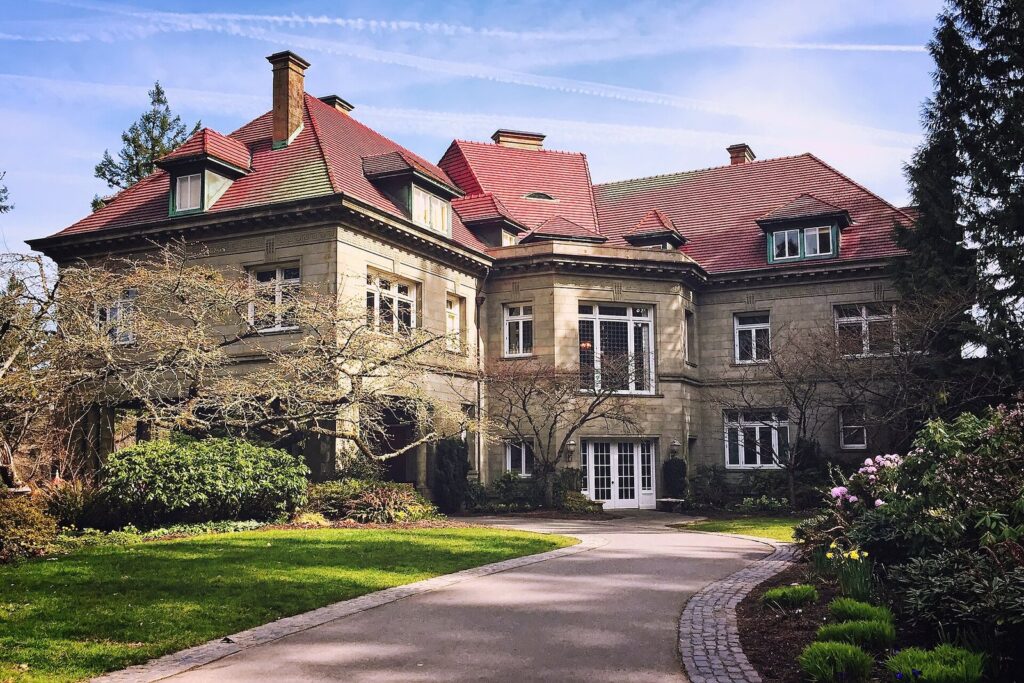
Pittock Mansion charges adults $17 to tour the house, open 9 a.m. to 4 p.m. in September 2026 (noon on Tuesdays), with hours that shift by season. The grounds are a free public park, open daily until 9 p.m., with views of as many as five Cascade peaks on a clear day.
Think twice if day two is a Sunday: no tram. Start at OMSI, which opens on Sundays, walk the Esplanade, and ride the streetcar’s loop across Tilikum Crossing for the bridge view. If it’s a Monday, OMSI is closed, so give the late morning to the Esplanade and the Central Eastside.
Three days in Portland: add the Columbia River Gorge
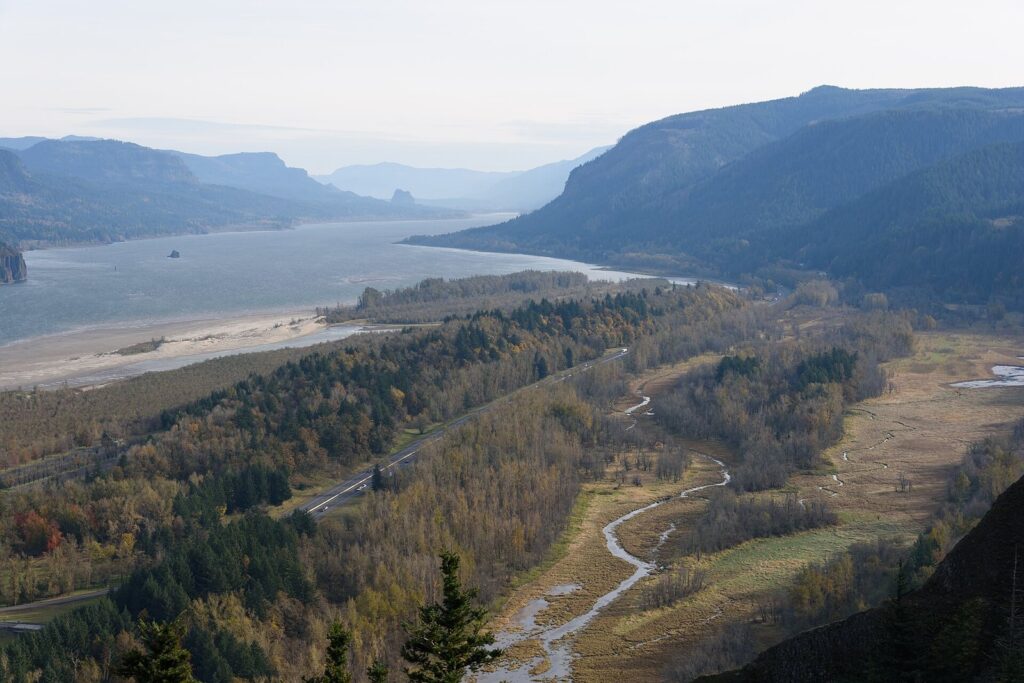
The Gorge is the right third day for most people. Multnomah Falls is about 30 miles east of downtown, Hood River about an hour’s drive, and the cliffs and waterfalls in between are the best scenery within easy reach of the city. Do it by car if you want the whole Historic Columbia River Highway. Do it by bus if Multnomah Falls and lunch in Hood River are enough.
By car: the waterfall road and Hood River
| Time | Stop | Getting there | Allow |
|---|---|---|---|
| 8:30 a.m. | Leave downtown | East on I-84 | About 40 min to Crown Point |
| 9:15 a.m. | Vista House at Crown Point | Up onto the Historic Columbia River Highway | 30 min |
| 10:00 a.m. | Latourell, Wahkeena and the smaller falls | East along the old highway | 60-75 min |
| 11:15 a.m. | Multnomah Falls | The old highway, or I-84 Exit 31 | 60 min |
| 12:30 p.m. | Lunch in Hood River | East on I-84 | 35-45 min drive |
| 2:00 p.m. | Hood River’s waterfront or the orchards south of town | Short drives | 2 hours |
| 4:00 p.m. | Back to Portland | West on I-84 | About 1 hour without traffic |
The old highway is narrow and its pullouts fill fast on summer weekends, so start early and move on when a lot is full instead of circling. Multnomah Falls’ I-84 lot needed a timed-entry permit from May 22 to September 7 in 2026, and the approach along the historic highway had its own rules, so check Recreation.gov for 2027 dates before a late-spring or summer trip. Outside that window, no permit is needed. Before leaving, check ODOT’s TripCheck for closures on the historic highway.
Fuel is simpler than its reputation: in Hood River County you can pump your own gas at any station, any hour, and Multnomah County stations may offer self-serve at up to half their pumps, at the same price as the attended ones.
Without a car: MAX and the Columbia Gorge Express
Take a MAX Red, Blue or Green Line train to Gateway Transit Center in Northeast Portland and transfer to the Columbia Gorge Express, which runs seven days a week to Troutdale, Multnomah Falls, Cascade Locks and Hood River. The spring 2026 timetable, still posted in late September, listed about a dozen trips each way, with the first bus leaving Portland at 7:20 a.m. and the last one back from Hood River at 6:40 p.m. Tickets are sold through the Token Transit app or as a GOrge Pass; check the operator’s fare page for prices. In extreme congestion the bus can skip the Multnomah Falls stop, one more reason to ride an early one.
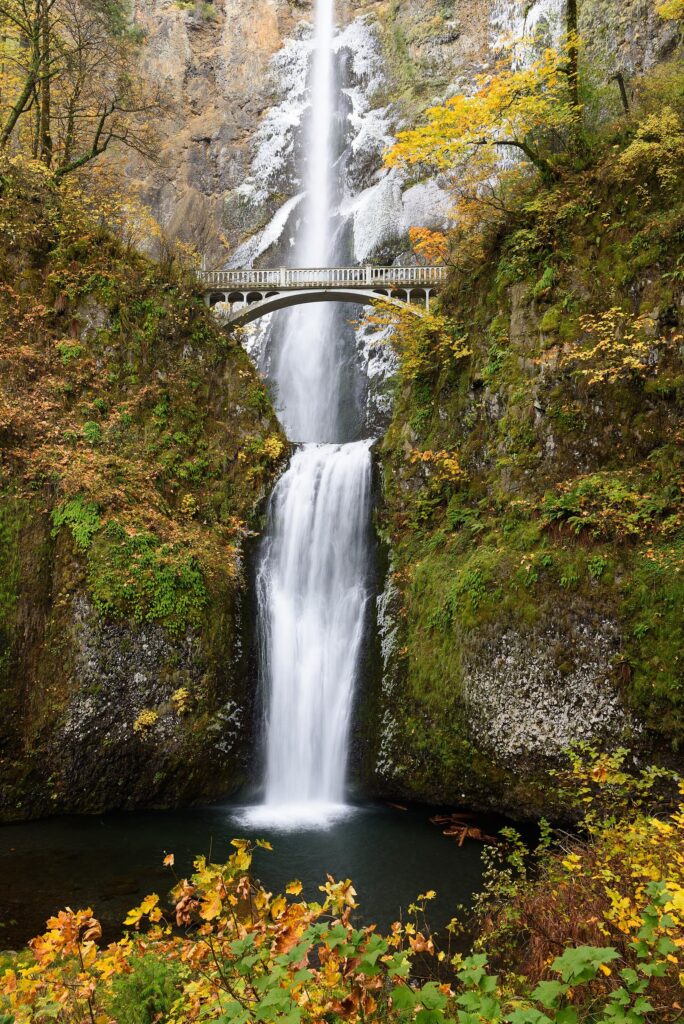
Verdict: the bus version gives you Multnomah Falls and Hood River. The car version adds Crown Point and the smaller waterfalls, which are most of what makes the old road worth driving. Either beats a third city day.
Four days or more: a second day trip and a slower pace
A fourth day buys a second trip out of town. The classic choices point in different directions (the coast west, Mount Hood east, wine country southwest), so give each its own day and don’t try to pair them.
| Day trip | Direction and drive | Best for | Watch for |
|---|---|---|---|
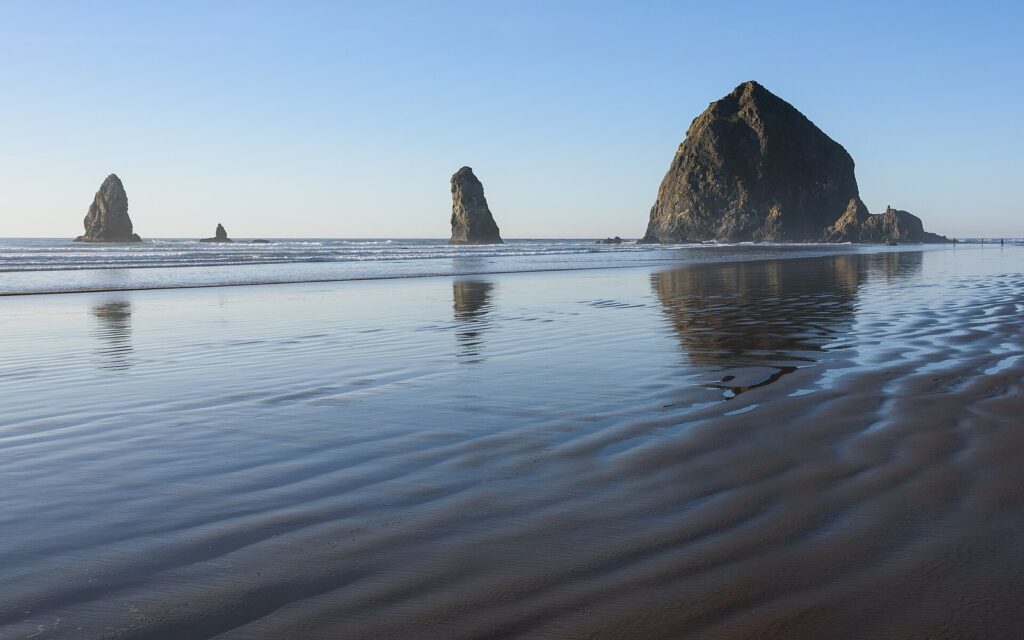
| Cannon Beach and Ecola State Park | About 80 miles west on US 26, roughly 1.5 hours each way | Haystack Rock, tide pools at low tide, long beach walks | Sneaker waves, logs in the surf, summer weekend traffic |
| Mount Hood and Timberline Lodge | About 60 miles east on US 26, roughly 1.5 hours | Summer trails and wildflowers; winter snow | In winter: traction tires or chains, Sno-Park permits, ODOT TripCheck |
| Willamette Valley wine country (Dundee Hills) | About 25-30 miles southwest on OR 99W, 45-60 min | Pinot noir tasting; harvest season in fall | A designated driver; many tasting rooms take reservations |
On the coast, sneaker waves can surge far up the beach in any season and are most frequent from fall through spring; the National Weather Service issues statements when they’re likely. Never turn your back on the ocean, stay off logs at the waterline, and check a tide table before heading for Haystack Rock’s tide pools.
Five to seven days
With a week, slow the city days down and add the neighborhoods the short plans skip:
- The West Hills: the Forest Park and Pittock morning above, then NW 23rd if you skipped it on day one.
- North and Northeast: N Mississippi Avenue, NE Alberta Street’s murals and galleries, and an evening in St. Johns, where Cathedral Park sits under the Gothic towers of the St. Johns Bridge.
- The south end: Sellwood’s antique and vintage shops and the Oaks Bottom wetlands.
- A night away: one night in Hood River or on the coast turns two rushed day trips into one unhurried one.
Portland also pairs well with Seattle. Amtrak Cascades trains run daily between Eugene and Vancouver, British Columbia, via Portland and Seattle, from Union Station at 800 NW 6th Ave. Three days in Portland and two or three in Seattle fill a week without a rental car. (Vancouver, Washington, is a different place: Portland’s neighbor across the Columbia.)
Can you do a Portland itinerary without a car?
Yes, for the city days and a bus-based Gorge day. Transit reaches every stop in the one- and two-day plans, and the fare rules keep it cheap: an adult TriMet fare is $2.80 for 2.5 hours, paid by tapping a contactless card or phone, and charges stop at $5.60 a day and $100 a month if you tap with the same card or phone. Honored Citizen fares (riders 65 and older, among others) and Youth fares are $1.40, capped at $2.80 a day. The streetcar takes the same fare; the Aerial Tram charges its own.
| Leg | How | Cost (adult) | Allow |
|---|---|---|---|
| PDX to downtown | MAX Red Line | $2.80 | About 39 min on the train, which runs about every 15 min |
| Downtown to Washington Park | MAX Red or Blue Line, then the Free Shuttle Loop | $2.80; shuttle free | 25-35 min to the station plaza, plus the shuttle wait |
| NW 23rd, the Pearl, PSU, South Waterfront | Portland Streetcar NS Line | TriMet fare | Live predictions online, accurate to within 2 min |
| The Pearl, the Convention Center, OMSI | Streetcar A and B Loops, over the Broadway Bridge and Tilikum Crossing | TriMet fare | A loop is a good way to see both bridges |
| South Waterfront to OHSU | Portland Aerial Tram | $9 round trip | A few minutes each way; no Sundays |
| Downtown to Hawthorne or Division | TriMet bus, or on foot over the Hawthorne Bridge | TriMet fare | The walk to Cartopia takes about 25 min |
| Portland to Multnomah Falls or Hood River | MAX to Gateway Transit Center, then the Columbia Gorge Express | TriMet fare plus the Express ticket | A full day |
Car-free has limits. Pittock Mansion sits at the top of a steep residential hill, and walking up from the nearest bus is a real climb; a rideshare up and a walk down through Forest Park is the smarter split. Beyond Multnomah Falls, the smaller waterfalls on the old highway, the coast, Mount Hood and the wineries all need a car or a tour.
What if it rains?
Plan for rain as a frequency, not a volume. NOAA’s 1991-2020 normals for Portland’s airport show 36.92 inches a year spread over about 157 days with measurable precipitation, which in practice means many gray days of light rain rather than downpours. The wet months are November (5.45 inches), December (5.77) and January (5.03); July and August get about half an inch each. Snow averages 4.2 inches a year, so it’s rare, but when ice does arrive, the hills get treacherous and transit slows.
Don’t cancel days for rain. Swap stops on the same side of the river:
| If the plan says | In steady rain, do this | Why it works |
|---|---|---|
| Rose Garden and the waterfront walk | Portland Art Museum (Tuesday-Sunday, 10 a.m.-5 p.m.) | Downtown and indoors, with the Mark Rothko Pavilion, opened in November 2025 |
| Portland Japanese Garden | Keep it | Moss, stone and water look better wet |
| Eastbank Esplanade | OMSI (closed Mondays) | Same riverbank, fully indoors |
| Mount Tabor at sunset | A Central Eastside brewery taproom | There’s no sunset through cloud anyway |
| Food cart dinner | A sit-down restaurant on Division or Hawthorne | Cart seating is often only partly covered |
| Crown Point viewpoint | The waterfalls, in a rain shell | Fog hides the view, but the falls run heavier in the wet months |
Verdict: rain only ruins the clear-day views: Crown Point, Pittock’s Cascade peaks, the tram’s upper deck. Put those on the driest forecast and let everything else fall where it falls.
How does the itinerary change by season?
| Season | Average high (NOAA) | What changes in the plan |
|---|---|---|
| Spring (March-May) | 62°F in April | Rhododendrons at Crystal Springs, roses from late May, the Rose Festival (2026: May 22-June 28); the Washington Park shuttle returns to every 15 minutes in April |
| Summer (June-August) | 81.9°F in July, 82.3°F in August | About half an inch of rain a month and long evenings; Multnomah Falls timed-entry permits (2026: May 22-Sept. 7); the Waterfront Blues Festival around the Fourth of July (2026: July 2-4) |
| Fall (September-November) | 64.4°F in October | Fall color at the Japanese Garden and Hoyt Arboretum; from October the shuttle runs 10 a.m.-4 p.m. every 30 minutes; the zoo closes at 3:30 p.m. in November; the PSU market opens at 9 a.m. from November 7 |
| Winter (December-February) | 46.9°F in December, 47.5°F in January | Short days and 5 to 6 inches of rain a month; the zoo opens only Friday-Monday until mid-December; snow on Mount Hood, with traction rules and Sno-Park permits |
Summer is the easiest season for these plans and the most crowded. Late September and October are the sweet spot: mild highs, fall color and no permit to book at Multnomah Falls. In winter, start later (no shuttle before 10), finish outdoors by about 4:30 in December, and move museums and Powell’s to the afternoons.
What does a day in Portland cost?
Attractions are the variable; transit is cheap and capped. Oregon has no sales tax, so the posted price is what you pay at the ticket desk, the food cart and the bookstore register. Hotels are the exception: Portland’s local lodging taxes and fees add 14.5% to room rates, and the state’s own lodging tax comes on top.
Per adult, the one-day plan costs $40.50 in admissions plus $5.60 in fares: $46.10 before food. Day two adds $31.50 for the tram and OMSI plus fares, or $17 if you take the Pittock swap. The Gorge day by car costs fuel and any parking fees; by bus, it’s a TriMet fare each way plus the Columbia Gorge Express ticket. And the best-value half of any plan costs nothing: the Rose Garden, Hoyt Arboretum, Forest Park, Mount Tabor, the Esplanade and Pittock’s grounds.
Portland, Oregon Itinerary FAQ
Is two days enough for Portland?
For the city itself, yes. Two days covers Washington Park, downtown, Old Town, the river and the close-in east side at a reasonable pace, and nothing essential needs a third city day. What two days can’t include is the Gorge, the coast or Mount Hood, which is why most people who can stretch to three spend the extra day out of town.
What’s the best day of the week to start a Portland trip?
Wednesday or Thursday. A Wednesday start puts your garden day on a day the Japanese Garden is open, gives you a weekday for the Aerial Tram, and lands Saturday on the farmers market and the Saturday Market. A first Thursday adds free admission at the art museum. If you have to start on a Monday, do the west side first.
What should I book before I arrive?
Very little. Japanese Garden tickets open 10 days ahead and are worth reserving for a weekend visit. The Oregon Zoo requires advance online tickets, sold up to 30 days out. In the summer permit season, the Multnomah Falls lot off I-84 needs a timed-entry reservation from Recreation.gov. Weekend dinners at popular restaurants are the only other thing that fills.
Can I see Portland on a long layover at PDX?
With six or more hours between flights, yes. The MAX Red Line reaches downtown in about 39 minutes, trains run about every 15 minutes, and one $2.80 fare covers 2.5 hours. Powell’s, Lan Su and the waterfront fit a three-hour loop. Leave plenty of time for security on the way back; PDX’s shops and restaurants charge street prices, so eating there costs no more.
Does this itinerary work with kids?
With a few swaps. OMSI and the Oregon Zoo, which sits beside Washington Park station and needs advance tickets, replace the art museum and the long Powell’s stop. The tram is free for kids 6 and under with a paying adult, and the Japanese Garden suits patient children only. Skip the Portland Children’s Museum that older lists mention; it has closed for good.
Is Portland walkable enough to skip rideshares?
Mostly. Downtown, Old Town, the Pearl and the waterfront are flat and connected, and the plans walk between everything there. Rideshares earn their fare in three places: up to Pittock Mansion, to the Japanese Garden gate at opening time on a winter morning, and home from Mount Tabor after dark if you’d rather not wait for a bus.
Related Portland Guides
- Things to Do in Portland, Oregon: the full list of sights these plans draw from, with hours and prices.
- Portland, Oregon Travel Guide: when to go, getting in from PDX, hotel taxes and what to book.
Sources and verification
The hours, fares, prices and schedules on this page were checked on September 24, 2026 against the agencies and operators listed below. The itineraries are compiled from those sources and claim no first-hand visits.
- Portland Japanese Garden
- Explore Washington Park: Free Shuttle Loop and parking
- Portland Parks & Recreation (Rose Test Garden, Forest Park, Eastbank Esplanade, Mill Ends Park)
- Hoyt Arboretum
- Lan Su Chinese Garden
- Pittock Mansion
- Portland Art Museum
- OMSI
- Oregon Zoo: hours and tickets
- Portland Aerial Tram: fares and hours
- TriMet fares
- Portland Streetcar
- Columbia Area Transit: Columbia Gorge Express
- Recreation.gov (Multnomah Falls timed entry)
- ODOT TripCheck
- Oregon State Fire Marshal: self-serve fueling
- Portland Saturday Market
- Portland Farmers Market at PSU
- Cartopia
- NOAA NCEI U.S. Climate Normals
- City of Portland Revenue Division: transient lodgings tax
- Amtrak Cascades: Portland station
Portland Tourism Guide is an independent publication, not affiliated with Travel Portland, the City of Portland or any business named here.
Photo credits
- Columbia River Gorge from Crown Point: photo by King of Hearts, Wikimedia Commons (CC BY-SA 4.0)
- Portland Japanese Garden: photo by King of Hearts, Wikimedia Commons (CC BY-SA 4.0)
- Lan Su Chinese Garden: photo by Daderot, Wikimedia Commons (CC0)
- Cartopia food cart pod: photo by Another Believer, Wikimedia Commons (CC BY-SA 4.0)
- Portland Aerial Tram: photo by Doug Kerr from Albany, NY, United States, Wikimedia Commons (CC BY-SA 2.0)
- Pittock Mansion: photo by Steven Pavlov, Wikimedia Commons (CC BY-SA 4.0)
- Multnomah Falls: photo by King of Hearts, Wikimedia Commons (CC BY-SA 4.0)
- Haystack Rock, Cannon Beach: photo by King of Hearts, Wikimedia Commons (CC BY-SA 4.0)
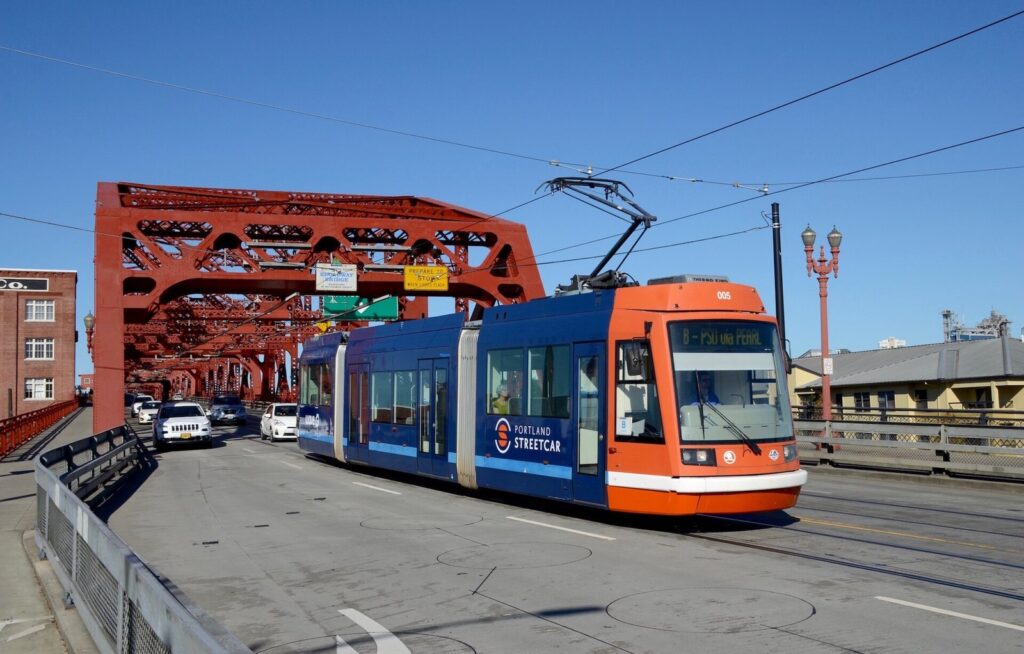
- Portland Streetcar on the Broadway Bridge: photo by Steve Morgan, Wikimedia Commons (CC BY-SA 4.0)