For most first visits, the answer to where to stay in Portland, Oregon is downtown or the Pearl District. Both sit on MAX or the streetcar, both put Powell’s, the waterfront and Washington Park one ride away, and between them they hold the city’s thickest cluster of hotels. Pick the Lloyd District for conventions, Moda Center events and a one-seat MAX ride from the airport; the close-in east side for food, bars and a neighborhood feel; and the airport strip only for an early flight.
This is for anyone choosing a base, from a first-timer without a car to a family with one. The caveat that matters most is the bill: Portland adds up to 14.5% in local lodging taxes and fees, and Oregon’s state lodging tax rises from 1.5% to 2.75% for stays ending on or after January 1, 2027, so a $200 room costs about $232 a night before parking. Taxes, transit and parking rules were checked September 24, 2026 against the city, state and transit agencies’ own websites; the hotels named were confirmed operating in 2026 listings.
On this page: Areas at a glance · By trip type · The areas, one by one · Hotel shortlist · What a room really costs · Parking · Noise and street conditions · Accessibility · Hotel or rental · FAQ
Which part of Portland is best to stay in?
The Willamette River splits Portland east from west and Burnside Street splits it north from south, and where you sleep decides how much of your trip is spent on a train. The central city on the west bank (downtown, the Pearl and Old Town) is compact and flat. The east bank is bigger, more residential and better for eating, with fewer hotels outside the Lloyd District. Here’s the comparison in one table.
| Area | Best for | Transit | Noise at night | Parking | Think twice if |
|---|---|---|---|---|---|
| Downtown (SW) | First visits, car-free trips, concerts and shopping | All five MAX lines, the streetcar | Moderate: trains, sirens, street sweepers | Nightly hotel charge; city garages | You want a neighborhood feel after 7 p.m. |
| Pearl District (NW) | Couples, walkers, galleries, restaurants | Streetcar NS Line and loops; MAX a few blocks east | Quiet | Meters and hotel garages | You want late-night energy |
| Old Town Chinatown | Lan Su, the waterfront, nightlife | MAX on 1st Ave and the transit mall | Loud on weekend nights | Garages, meters | You’re a light sleeper or traveling with young kids |
| Nob Hill / NW 23rd | Repeat visits, Forest Park, quiet streets | Streetcar NS Line; buses | Quiet | Tight | You want a wide choice of hotels |
| Lloyd District and Rose Quarter (NE) | Conventions, Moda Center events, PDX by MAX | MAX Red, Blue and Green; streetcar loops | Quiet, except event nights | Easier than downtown | You want to walk to lots of dinner options |
| Central Eastside and East Burnside | Food, breweries, bars | Streetcar loops; buses | Lively on weekends | Meters, some free side streets | You want a quiet night |
| Southeast and Northeast neighborhoods | Longer stays, families, food streets | Buses; little MAX | Quiet and residential | Usually easy on the street | You’re car-free with a west-side plan |
| Airport (Cascade Station) | Early flights, one-night stopovers | MAX Red Line | Quiet, some aircraft | Easiest | You came to see the city |
Where should you stay for your kind of trip?
The best area depends less on the city than on the trip. Match yours to a row, then read that area’s section below.
| Your trip | Stay in | Why | Runner-up |
|---|---|---|---|
| First visit, no car | Downtown | Every MAX line and the streetcar; walk to Powell’s, the waterfront and Pioneer Courthouse Square | The Pearl |
| Couple on a food trip | Central Eastside or the Pearl | Walk to dinner, cart pods and taprooms | A rental near Division or Hawthorne |
| Family with kids | Downtown near a MAX Red or Blue stop, or the Lloyd District | One train to the zoo; OMSI a streetcar ride away | A Southeast rental with a kitchen |
| Convention or business | Lloyd District | Walk to the convention center; MAX Red straight to PDX | Downtown |
| Moda Center concert or game | Lloyd District or Rose Quarter | Walk back after the show | Downtown, a few MAX stops away |
| Timbers or Thorns match | Downtown’s west end | Walk to Providence Park | Anywhere on the MAX Red or Blue Line |
| Road trip with a car | Lloyd District or the east side | Easier parking; quick onto I-84 for the Gorge and I-5 north or south | The airport strip |
| Tight budget | The airport strip or the east side | Hotels outside the core usually undercut downtown, though downtown weekends can compete | A room in a shared rental |
| Early flight | Airport (Cascade Station) | Minutes from the terminal | Lloyd District, one MAX ride to PDX |
| A week or longer | Nob Hill or a Southeast rental | Grocery stores, laundry and a street to call your own | The Pearl |
If you already know what you want to see, check it against our day-by-day Portland plans before booking: a trip built around Washington Park and the Gorge argues for a different base than one built around Division Street’s restaurants.
The best areas to stay in Portland, one by one
Downtown: the default, for good reasons
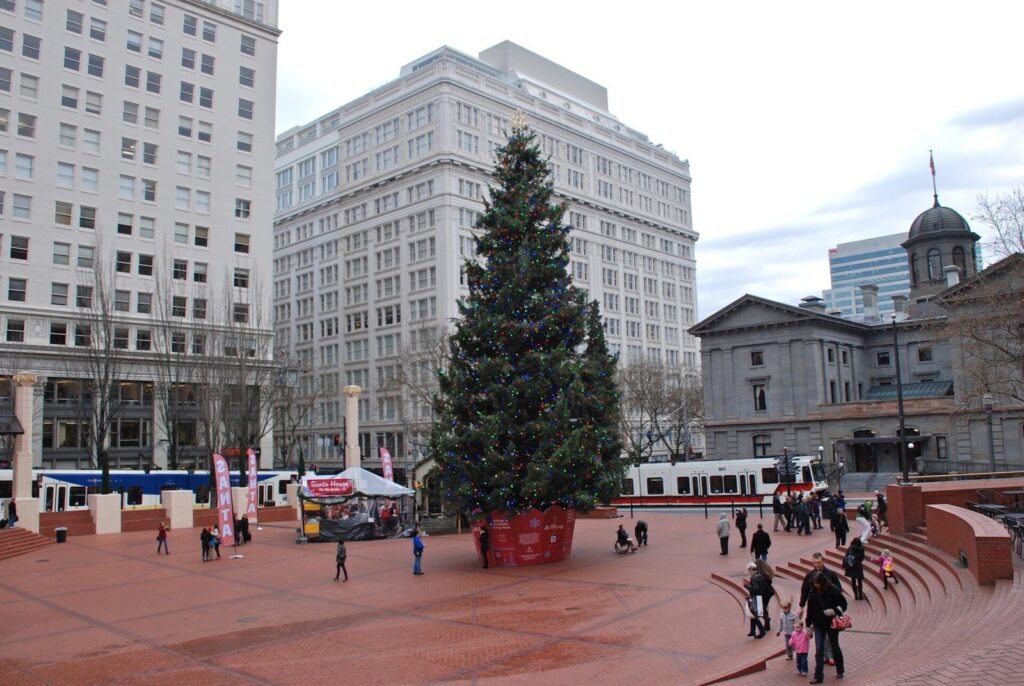
Downtown is the office and shopping core of Southwest Portland, from the river west to I-405. All five MAX lines run through it, crossing at Pioneer Courthouse Square, and the streetcar runs along SW 10th and 11th. That makes it the one base where you can reach the airport, Washington Park, the Pearl and the east side without a transfer or a car. Blocks are short, the grid is easy, and Powell’s, the art museum, the waterfront and the concert halls are all walkable.
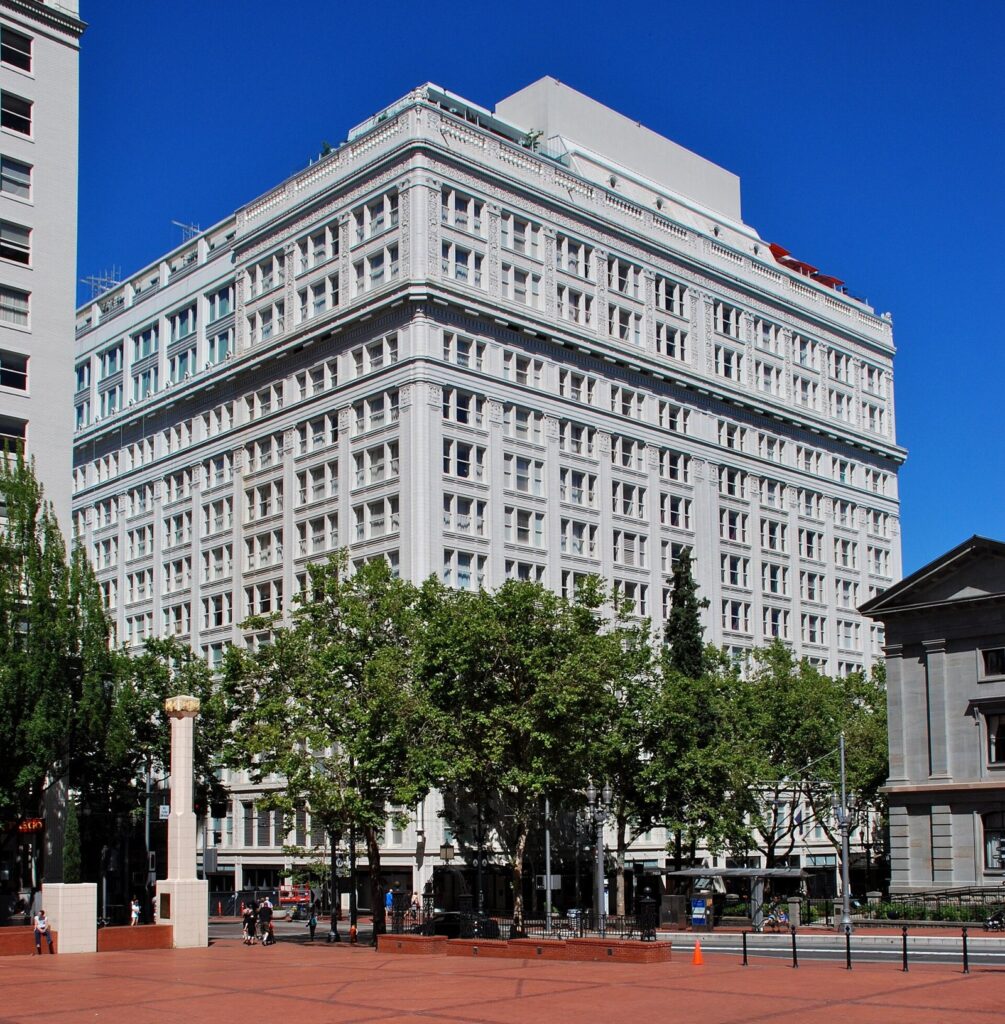
Hotels here run from historic to glass tower. The Nines, a Luxury Collection hotel on the upper floors of the old Meier & Frank department store, overlooks Pioneer Courthouse Square and sits on the MAX line. The Heathman Hotel is on SW Broadway next to the Arlene Schnitzer Concert Hall, which is handy on symphony nights. Woodlark is a boutique hotel in the retail core, Hotel deLuxe is a few blocks from Providence Park on the west end, and The Ritz-Carlton, Portland fills a 35-story tower with 251 rooms and condos above. Big-brand towers fill in the rest, and they’re where weekend deals tend to show up once the business travelers go home.
Verdict: for a first visit without a car, downtown wins on transit alone. Think twice if you want an evening stroll to dozens of restaurants from your door. Downtown empties after the offices close, and some blocks feel deserted by 8 p.m. The Pearl, ten minutes’ walk north, fixes that.
Pearl District: the walker’s choice
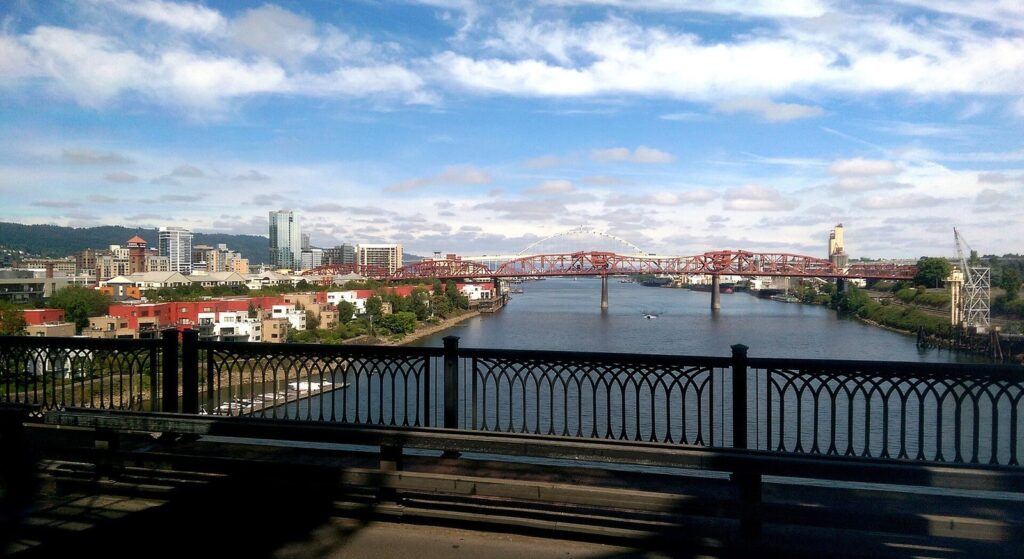
The Pearl is a former rail yard and warehouse district north of Burnside, turned over the last few decades into loft buildings, galleries, restaurants and small parks. It’s quieter at night than downtown, busier with people walking dogs and going to dinner, and flat enough to cover on foot. Powell’s sits on its southern edge at W Burnside, Union Station on its northeastern edge at 800 NW 6th Ave, and the streetcar’s NS Line and loops run through the middle.
Canopy by Hilton Portland Pearl District, near Portland Center Stage at the Armory, is the obvious hotel pick. The Pearl has fewer hotels than downtown, so compare it with a downtown room a few blocks south of Burnside, which gives you most of the same walk for less choice paralysis.
Verdict: the best base for couples and walkers who want to step out the door into dinner. Think twice if you’ll ride MAX every day: the nearest stations are along the neighborhood’s eastern edge, so allow up to a 10-minute walk.
Old Town Chinatown: history, nightlife and tradeoffs
Old Town Chinatown is the oldest part of the city, between the Pearl and the river north of Burnside. It holds Lan Su Chinese Garden, the Saturday Market’s riverside home and some of the best-preserved 19th-century buildings in Portland, and two of the more interesting hotels. The Hoxton Portland has more than 400 works of art across the property, and The Society Hotel occupies a restored 19th-century building a few blocks away. MAX Red and Blue trains stop at Old Town/Chinatown station on NW 1st Avenue, and the transit mall’s lines stop a few blocks west.
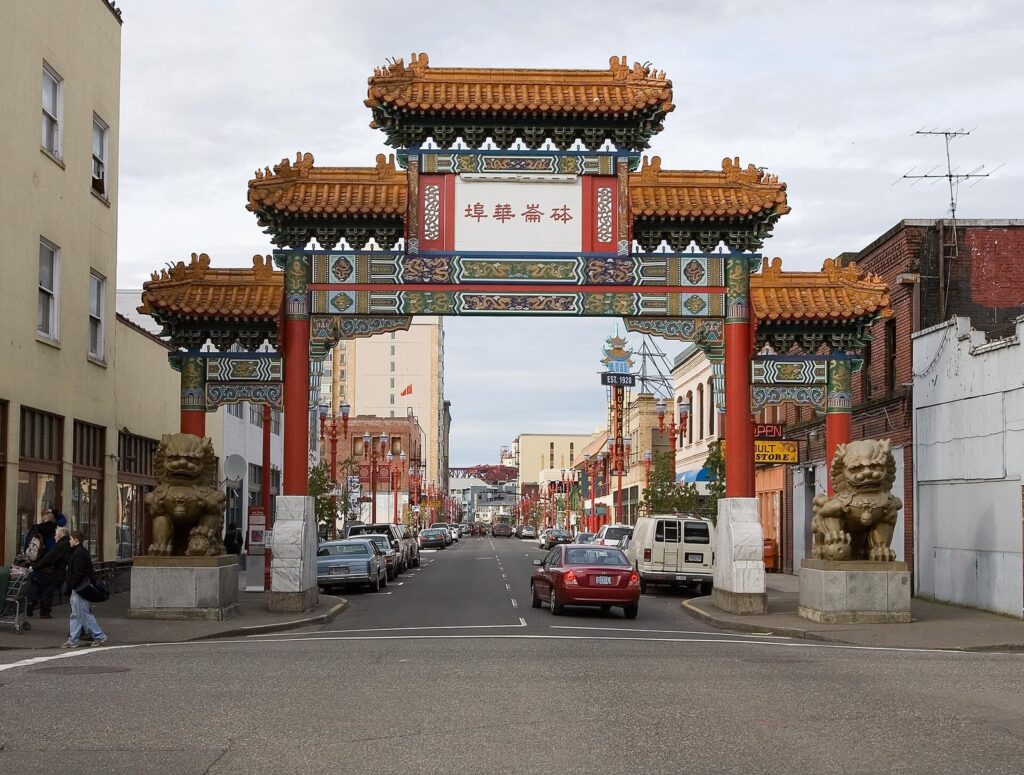
The tradeoffs are real. Old Town has the city’s densest cluster of late-night bars and clubs, so weekend nights run loud until closing time. Some blocks also have visible homelessness and street disorder that varies from week to week. Think twice if you’re a light sleeper, traveling with young children or arriving late at night without a plan; otherwise, ask for a high floor away from the street and enjoy being the closest hotel guest to Lan Su’s gate.
Nob Hill and NW 23rd: a neighborhood base
Northwest Portland’s Nob Hill, centered on NW 23rd Avenue, is a grid of old houses and apartment blocks with a main street of shops and cafes. It has few hotels, so most stays here are rentals, and it suits people who’ve seen the center and want a quieter base near Forest Park. The streetcar’s NS Line starts at NW 23rd and Marshall and runs to the Pearl, downtown, Portland State and South Waterfront. The Lower Macleay trailhead into Forest Park is about a 15-minute walk from the north end of 23rd.
Think twice if you’re bringing a car. Street parking in Northwest is metered or permit-limited near the commercial blocks and tight everywhere, and a rental with no off-street space turns every evening into a parking hunt.
Lloyd District and the Rose Quarter: conventions, concerts and PDX by train
Across the Steel Bridge from Old Town, the Lloyd District holds the Oregon Convention Center, the Moda Center and a cluster of large hotels. The Hyatt Regency Portland at the Oregon Convention Center opened in December 2019 with 600 rooms on 14 floors, directly beside the convention center; Hotel Eastlund is nearby. MAX Red, Blue and Green trains stop at Rose Quarter, Convention Center and two more stations to the east, and the streetcar loops stop at the convention center.
The Red Line is the big advantage. It runs from the airport through the Lloyd District to downtown without a transfer, so a Lloyd hotel is one seat from PDX, and downtown is a few stops west. Parking is easier than on the west side, and I-84 starts here for the Gorge.
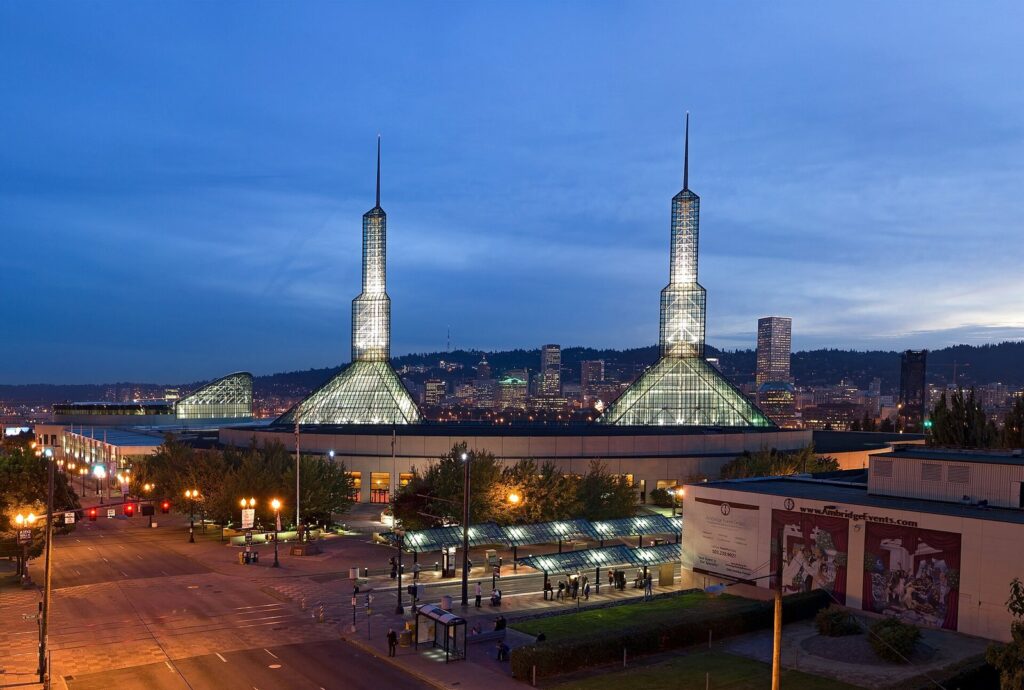
Verdict: the best pick for conventions, events at the Moda Center and anyone who wants the airport train at the door. Think twice if you want character on the doorstep: the streets around the big hotels are wide, quiet and short on places to eat after 9 p.m.
Central Eastside and East Burnside: the food and bar base
The Central Eastside is the old warehouse district along the east bank, now full of breweries, distillery tasting rooms, coffee roasters, restaurants and cart pods, with East Burnside running through its north end. Hotels are fewer and more design-minded. KEX Portland sits a five-minute streetcar ride from the convention center, and Jupiter NEXT is on East Burnside, about two miles from OMSI. The streetcar loops cross the Broadway Bridge and Tilikum Crossing from here, and buses on Burnside run straight downtown.
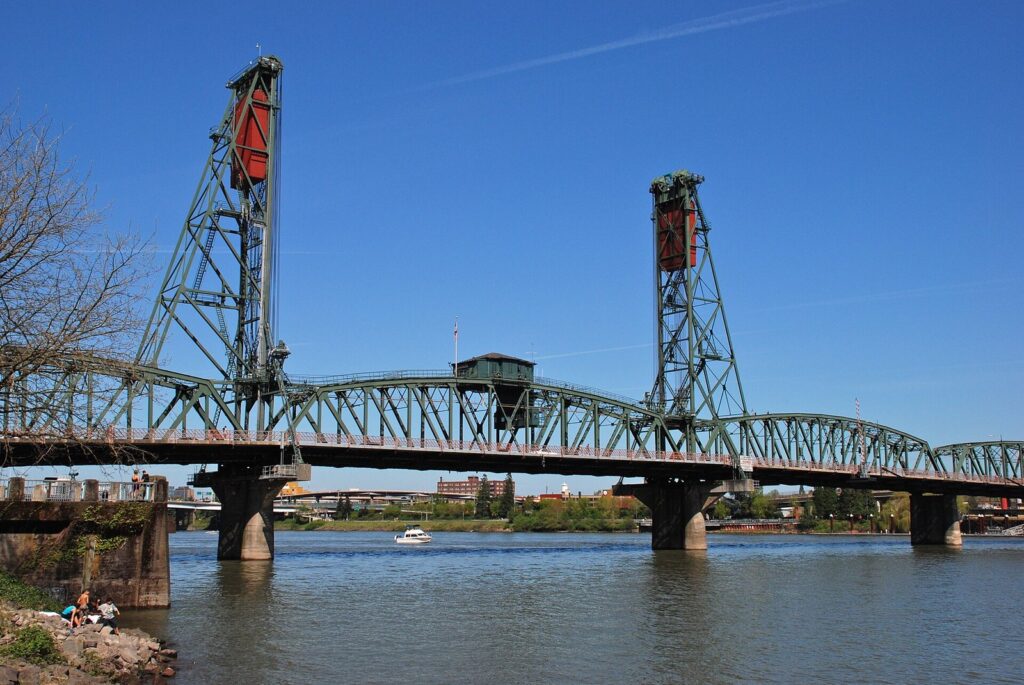
Verdict: the base for eating and drinking your way through a trip. Think twice if sleep matters more than dinner. Weekend nights on East Burnside are loud, and rooms facing I-5, which runs along the east bank, pick up freeway hum.
Southeast and Northeast neighborhoods: rentals and a slower pace
Beyond the close-in districts, Southeast (Hawthorne, Division, Belmont, Sellwood) and Northeast (Alberta, Mississippi, Irvington, Concordia) are residential neighborhoods with commercial main streets. Stays here are mostly short-term rentals and small inns, with one standout hotel: McMenamins Kennedy School, a converted elementary school in Northeast Portland with a soaking pool, several bars and a movie theater. Frequent buses run the main streets to downtown, but few of these areas have MAX, so plan on buses, bikes or a car.
Verdict: the right base for a week, a family that wants a kitchen and a yard, or a trip organized around food streets. Think twice if most of your plans are on the west side and you have no car; a daily 30-minute bus ride each way adds up.
The airport strip: for early flights only
Brand hotels cluster around Cascade Station, a shopping area near PDX with its own MAX Red Line stops, and along the roads into the airport. Most run airport shuttles; confirm when you book. They’re usually cheaper than downtown and make sense before a 6 a.m. flight or after a midnight arrival. For anything else, remember that downtown is only about 39 minutes from PDX on the Red Line, with trains about every 15 minutes, so saving money by staying at the airport tends to cost you the evening.
Vancouver, Washington, and the suburbs
Across the Columbia River, Vancouver, Washington, sometimes undercuts Portland on price, but no MAX line crosses the river, the I-5 and I-205 bridges back up at rush hour, and Washington’s own taxes apply to your room there. Suburban hotels in Beaverton, Tigard or Troutdale make sense for a car-based trip with business in those areas or a Gorge-first itinerary, less so for seeing the city.
Bases that look close on a map but aren’t
A few hotel clusters sit inside the metro area and still put you a long way from the sights without a car. The far ends of the MAX Blue Line, in Gresham to the east and Hillsboro to the west, mean a long ride each way for every city day. Hayden Island, on the Columbia beside the I-5 bridge, has no MAX station; the Yellow Line stops short of it at the Expo Center. And the office-park hotels off US 26 and I-5 in Beaverton and Tigard are built for business in the suburbs, not for Powell’s and the Pearl.
If your trip is built around day trips rather than the city, pick the side of town that faces them. The Lloyd District and the east side sit on I-84 for the Columbia River Gorge and closest to US 26 east for Mount Hood. The west side is on US 26 west for the coast, and the south end of downtown is the quickest start onto OR 99W for Willamette Valley wine country. A central hotel still beats all of them for a mix of city days and day trips.
Portland hotel shortlist by style
These are the hotels named on this page, sorted by the kind of stay they suit. Each was operating in 2026 listings. Check rates and fees directly: Portland’s nightly prices swing more with the calendar than with the star rating, and a luxury room on a February Sunday can cost less than a brand hotel on a June Saturday.
| Style | Hotel | Area | Best for | Nearest transit |
|---|---|---|---|---|
| Luxury | The Nines | Downtown | A splurge overlooking Pioneer Courthouse Square | MAX at the door |
| Luxury | The Ritz-Carlton, Portland | Downtown | A new tower with high-floor rooms | MAX a block or two away |
| Historic | The Heathman Hotel | Downtown | Concerts at the Schnitz next door | Streetcar and MAX within a few blocks |
| Boutique | Woodlark | Downtown | Design-minded couples | MAX a block or two away |
| Boutique | Hotel deLuxe | Downtown’s west end | Timbers and Thorns matches | MAX at Providence Park |
| Boutique | The Hoxton Portland | Old Town Chinatown | Art, bars and the waterfront | MAX in Old Town |
| Value boutique | The Society Hotel | Old Town Chinatown | A central base on a smaller budget | MAX in Old Town |
| Brand | Canopy by Hilton Portland Pearl District | Pearl District | Walking to dinner | Streetcar |
| Convention | Hyatt Regency Portland at the Oregon Convention Center | Lloyd District | Conventions, and PDX by train | MAX at Convention Center |
| Convention | Hotel Eastlund | Lloyd District | Convention and Moda Center stays | MAX and streetcar |
| Lively | Jupiter NEXT | East Burnside | Bars and late nights | Buses on Burnside |
| Lively | KEX Portland | Central Eastside | Food and taprooms | Streetcar |
| Only in Portland | McMenamins Kennedy School | Northeast | A soaking pool, bars and a cinema in an old school | Bus |
Two things this list deliberately leaves out: nightly prices, which change too fast to print honestly, and hostels, since the central city’s traditional hostels have thinned out in recent years. For the cheapest central beds, compare the value boutiques above with a room in a shared rental.
How much does a Portland hotel room really cost?
Nightly rates move with the calendar, so this page won’t quote them. What doesn’t move is the tax math, which catches visitors who assume Oregon’s lack of a sales tax extends to hotels. It doesn’t. The city’s Revenue Division lists three local charges on lodging, and the state adds its own.
| Charge | Stays ending in 2026 | Stays ending January 1, 2027 or later |
|---|---|---|
| City of Portland transient lodgings tax | 6% | 6% (as listed in September 2026) |
| Multnomah County transient lodging tax | 5.5% | 5.5% |
| Portland Tourism Improvement District fee | 3% | 3% |
| Oregon state transient lodging tax | 1.5% | 2.75% |
| Total on the room rate | 16% | 17.25% |
| A $200 room, per night | $232 | $234.50 |
Two details matter. A stay that starts in 2026 and ends on or after January 1, 2027 pays the 2.75% state rate on the whole stay, so a New Year’s trip gets the higher rate from night one. And short-term rental hosts and booking platforms owe an extra $4 per night fee in Portland, which usually lands on your bill (commercially zoned bed-and-breakfasts are exempt).
On top of tax, look for three line items before you click book: parking, which downtown hotels charge nightly; any amenity or destination fee; and pet or early check-in fees. Outside the hotel, Oregon’s lack of a sales tax works in your favor: the price on the menu or the shelf is the price you pay.
What pushes Portland room rates up or down
- Summer. June through August is peak season, with the driest weather and the longest days.
- Festivals and events. The Rose Festival (May 22 to June 28 in 2026), the Waterfront Blues Festival over the Fourth of July (July 2-4 in 2026), large conventions and big concerts at the Moda Center fill central hotels.
- Graduation and holiday weekends. Late spring graduation weekends and holiday weekends book up early.
- Day of the week. Downtown and Lloyd hotels lean on business travel, so weekends can be cheaper there, while neighborhood rentals often run the other way.
- Winter. November through February, outside the holidays, is the low season: wetter, darker, and usually the best time to try a hotel you couldn’t justify in August.
Parking: what it costs and how to avoid paying for it
If you’re staying in the central city, the cheapest parking space is the one you don’t need. The MAX Red Line runs from PDX to downtown in about 39 minutes for a $2.80 fare, TriMet caps adult fares at $5.60 a day when you tap the same card or phone, and the streetcar takes the same fare. A rental car for only the day you drive to the Gorge or the coast usually costs less than a week of hotel parking.
If you do bring a car, compare three options before paying the hotel’s nightly rate:
- City garages. The Portland Bureau of Transportation runs five SmartPark garages downtown. Their rates went up on July 1, 2026 (15 cents more per hour and $1 more for the weekday all-day rate), so check the current rate sheet on the city’s site.
- Street meters. Downtown and Northwest meters take the ParkingKitty app. Time limits and enforcement hours vary by district and have changed recently, so read the sign on the block.
- The east side. Lloyd District and Central Eastside hotels usually make parking easier, and residential Southeast and Northeast streets are mostly free.
Plan for paid parking at sights too: Washington Park charges $2.40 an hour or $9.60 a day, enforced 9:30 a.m. to 8 p.m. daily. That’s one more reason to leave the car at the hotel and take MAX up the hill.
Is downtown Portland noisy or unsafe to stay in?
Noise in the central city comes from predictable places. MAX trains ring their bells along 1st Avenue, the transit mall on 5th and 6th, and Morrison and Yamhill. Old Town’s clubs let out at closing time on weekends. On the east bank, I-5 and I-84 run along the river and the Lloyd District’s edge. Ask for a high floor on the side away from those, and most central hotels are quiet enough.
Street conditions are the question many visitors really mean. Portland’s central city has visible homelessness, concentrated on some blocks of Old Town, downtown and the east bank, and it changes block by block and month by month. For most visitors it’s a matter of awareness rather than danger. Use the same habits you’d use in any big American downtown: walk busy, well-lit streets at night, keep valuables out of sight in parked cars, and take a rideshare if you’re heading back late to a block you don’t know. If this is a deciding factor, the Pearl, the Lloyd District’s hotel cluster and the Southeast and Northeast neighborhoods feel calmer after dark than Old Town.
Which areas are easiest with limited mobility?
The central city is the easy part of Portland. Downtown, the Pearl, Old Town and the Lloyd District are flat, with short blocks and curb ramps, and MAX trains and streetcars are wheelchair-accessible. The hills are where it gets harder. Washington Park, Pittock Mansion and the rest of the West Hills are steep, although the Washington Park MAX station has elevators to the surface and the park’s free shuttle stops at the main attractions. Nob Hill is level along 23rd and climbs quickly to the west. On the east side, Hawthorne, Division, Alberta and the Lloyd District are mostly flat, while Mount Tabor and parts of Northeast rise sharply.
When you book, confirm the specific features you need, such as a roll-in shower rather than a tub, and ask how the entrance works: some of the city’s historic buildings have steps at the main door and a separate step-free entrance. A central hotel near a MAX station keeps both the sights and the airport a level ride away.
Should you book a hotel or a short-term rental?
Short-term rentals make the most sense in the residential neighborhoods, where hotels are scarce: Southeast, Northeast and Nob Hill. They suit families, groups and anyone staying a week, and they usually come with free street parking and a kitchen. The costs hide in the extras: cleaning fees, service fees and Portland’s $4 per night rental fee, on top of the same lodging taxes a hotel pays.
Hotels win for short stays, car-free trips and late arrivals. In the central city they’re closer to transit than most rentals, there’s someone at the desk when your flight is delayed, and the total price is simpler to compare. For a trip of three nights or fewer, a central hotel is usually the better value once fees are counted.
For the rest of the planning (when to go, getting in from PDX, what to book ahead), our Portland, Oregon travel guide covers the basics, and our list of the best things to do in Portland shows what’s within reach of each base.
Where to Stay in Portland FAQ
What’s the best area to stay in Portland for a first visit?
Downtown, with the Pearl District a close second. Downtown has the most hotels and every MAX line, so the airport, Washington Park and the east side are each one ride away. The Pearl is quieter and better for walking to dinner, and it’s still on the streetcar. Either one lets you skip renting a car until the day you leave town.
Is it better to stay on the east side or the west side?
West for sights and transit, east for food and neighborhoods. The west bank has Washington Park, downtown, the Pearl and most hotels. The east bank has the Central Eastside, Hawthorne, Division and Alberta, plus easier parking. If your trip is mostly eating and you have a car, the east side often makes the better base.
Do I need a car if I stay downtown?
Not for the city. MAX, the streetcar and your feet cover downtown, the Pearl, Old Town, Washington Park and the close-in east side, and the fare cap keeps a full day of rides at $5.60. Rent a car only for days you leave town, such as the coast or Mount Hood; the Columbia Gorge Express bus covers Multnomah Falls and Hood River.
How far ahead should I book a Portland hotel?
For summer weekends, Rose Festival dates and big convention weeks, book as soon as your dates are firm, since central hotels fill and prices climb. For winter and midweek stays, a few weeks ahead is usually enough. Whenever you book, compare the total with taxes and parking, not the headline nightly rate.
Is Vancouver, Washington, a good place to stay for Portland?
Only with a car and a reason to be north of the river. No MAX line crosses the Columbia, rush-hour traffic on the I-5 and I-205 bridges is slow, and Washington’s taxes apply to your room. The savings over a Lloyd District or airport hotel rarely survive the commute.
What if my flight lands late at PDX?
Book downtown or in the Lloyd District, where the MAX Red Line from the airport stops close to the hotels, and check the last train of the night on TriMet’s trip planner before you fly. If you land after it, a rideshare or taxi from PDX to either area is short. A hotel with a 24-hour front desk saves trouble with late check-in.
Where should families with kids stay in Portland?
Downtown near a MAX Red or Blue stop, or the Lloyd District. Both put the Oregon Zoo one train ride away at Washington Park station, and OMSI is a short streetcar or MAX ride. For a week, a Southeast rental with a kitchen and laundry often beats two hotel rooms, especially with a car for day trips.
Related Portland Guides
- Portland, Oregon Travel Guide: when to go, getting in from PDX and the costs to budget for.
- Portland, Oregon Itinerary: timed one- to four-day plans that start from a central base.
- Things to Do in Portland, Oregon: the sights, with hours and prices, grouped by area.
Sources and verification
Tax rates, transit details and parking rules on this page were checked on September 24, 2026 against the agencies listed below, and each hotel named was confirmed operating in 2026 hotel listings. The guide is compiled from those sources and claims no first-hand stays.
- City of Portland Revenue Division: transient lodgings tax
- Oregon Department of Revenue: state transient lodging tax
- Portland Bureau of Transportation: SmartPark garages
- Portland Bureau of Transportation: public parking guide
- TriMet fares
- TriMet: MAX to and from PDX
- Portland Streetcar
- Explore Washington Park: parking
- Amtrak: Portland Union Station
Portland Tourism Guide is an independent publication, not affiliated with Travel Portland, the City of Portland or any business named here.
Photo credits
- Pearl District and the Broadway Bridge: photo by Alfred Twu, Wikimedia Commons (CC0)
- Meier & Frank Building: photo by Steve Morgan, Wikimedia Commons (CC BY-SA 3.0)
- Chinatown Gate, Portland: photo by User:Cacophony, Wikimedia Commons (CC BY-SA 2.5)
- Oregon Convention Center: photo by Fcb981 edit by Noodle snacks, Wikimedia Commons (CC BY-SA 3.0)
- Hawthorne Bridge: photo by Steve Morgan, Wikimedia Commons (CC BY-SA 3.0)
- Pioneer Courthouse Square: photo by Steve Morgan, Wikimedia Commons (CC BY-SA 3.0)