The best free things to do in Portland, Oregon aren’t consolation prizes. The International Rose Test Garden and Hoyt Arboretum cost nothing, and neither do Forest Park’s 80-plus miles of trail, the lawn and view at Pittock Mansion, the river loop across the Willamette’s bridges or the volcanic summit of Mount Tabor. Powell’s City of Books is free to browse until closing, the Portland Art Museum is free on the first Thursday of each month, and the Grotto’s Plaza Level is free every day. The real cost is getting around: a TriMet fare is $2.80 for 2.5 hours, and you never pay more than $5.60 in a day.
This page is for budget travelers, families and anyone with spare hours between paid tickets, organized as routes by area so your free stops line up. One caveat matters more than the rest: in Portland, “free” rarely includes parking, and a few places that older lists call free now charge. Every price, hour and rule here was checked between September 23 and October 1, 2026 against the operators’ and agencies’ own websites. For the paid headliners too, start with our complete guide to things to do in Portland, Oregon.
Free things in Portland at a glance
Here’s the short list, with the honest catch for each. The times assume a relaxed pace, not a race.
| Free thing | Area | Time to allow | Best time | Works in rain? | The catch |
|---|---|---|---|---|---|
| International Rose Test Garden | Washington Park, SW | 45-60 minutes | Late May to October | No | Parking is $2.40 an hour; MAX and the free shuttle avoid it |
| Hoyt Arboretum | Washington Park, SW | 1-2 hours | October, for the maples | Under the trees, mostly | Trails mix pavement, dirt and stairs |
| Pittock Mansion grounds | West Hills, NW | 30-60 minutes | Clear evenings | No | The lot is paid; the free turnouts are below the house |
| Forest Park and the Witch’s Castle | Northwest | 1-3 hours | Any season | Better than most | Mud from fall into spring |
| Waterfront Park and the Eastbank Esplanade | Both banks, central | 1-2 hours | Any dry spell | No | None worth naming |
| Powell’s City of Books | W Burnside St | 1-2 hours | Rainy afternoons | Yes | Leaving without a book |
| Portland Art Museum | South Park Blocks | 2-3 hours | First Thursday, 10 a.m.-7 p.m. | Yes | Free for adults one day a month |
| Mount Tabor Park | Southeast | 1-2 hours | Sunset | No | Park roads are closed to cars on Wednesdays |
| The Grotto, Plaza Level | Northeast | 45-60 minutes | Daytime | Partly (the chapel) | The Upper Gardens are paid |
What does a free day in Portland actually cost?
Admission is only half the picture. The other half is moving between free places, and that’s where a free day quietly becomes a $30 one. Parking at Washington Park costs $2.40 an hour, up to $9.60 a day, enforced from 9:30 a.m. to 8 p.m. daily. Downtown meters rose 20 cents an hour on July 1, 2026, to about $3.40, plus small per-transaction fees. A car makes sense for the far-flung places on this list; for the rest, transit wins.
TriMet suits exactly this kind of day. Tap a contactless card or phone when you board, and each $2.80 tap covers 2.5 hours on MAX light rail, buses and the Portland Streetcar. Adult fares cap at $5.60 a day, so after two taps the rest of the day is free. Children 6 and under ride free with a paying rider, and the youth fare for ages 7 to 17 is $1.40. Our guide to getting around Portland covers the lines, the tickets and when a car is worth it.
| How you get around | What it costs (October 2026) | Good for |
|---|---|---|
| On foot | $0 | Downtown, Old Town, the Pearl and the river loop |
| TriMet: MAX, bus and streetcar | $2.80 per 2.5 hours, capped at $5.60 a day | Washington Park, the east side and the Grotto |
| TriMet youth (7-17) or Honored Citizen fare | $1.40 a ride, capped at $2.80 a day | Teens, and riders who qualify for TriMet’s reduced fare |
| BIKETOWN e-bike | $1 to unlock, plus 35 cents a minute | Short hops across the east side |
| Washington Park parking | $2.40 an hour, $9.60 a day | Groups with a picnic, or anyone who can’t do much walking |
One more thing in your favor: Oregon has no general sales tax, so the few prices you do pay are the prices on the sign.
Which free plan fits your day?
Portland’s free attractions cluster in a handful of areas, and the weather decides more than the map does. NOAA’s 1991-2020 normals for the airport show measurable rain on about 13 or 14 days in an average October, 18 in November and 19 in December, and fewer than four in July or August. Rain here is frequent rather than heavy, so a drizzly morning rarely writes off the afternoon. Plan a dry-weather route and keep an indoor backup one short ride away.
| If… | Do this | Skip |
|---|---|---|
| You have half a day and it’s dry | MAX to Washington Park for the Rose Garden and Hoyt Arboretum | Driving up and paying to park |
| You have half a day and it’s pouring | The Central Library, Powell’s and Pioneer Courthouse Square | Hoyt’s dirt trails, and the park shuttle, which doesn’t run in bad weather |
| It’s the first Thursday of the month | The art museum (free 10 a.m.-7 p.m.), then Pearl District galleries in the evening | Paying $27.50 for the museum another day if your dates are flexible |
| You’re staying on the east side | The Esplanade, Ladd’s Addition, Laurelhurst Park and Mount Tabor at sunset | Crossing the river only to cross back |
| You want a real hike | Lower Macleay to the Witch’s Castle and on to Pittock Mansion | Trying it in sneakers after a week of rain |
| You’d rather avoid hills and steps | The river loop, the Central Library and Oaks Bottom’s paved trail | Mount Tabor’s stairs and the uphill walk to Pittock |
Route 1: How do you see Washington Park for free?
Washington Park covers 410 acres of gardens and forest in the West Hills, and its two best gardens for budget travelers cost nothing. The trick is arriving without a car. MAX Red and Blue Line trains run every 15 minutes to Washington Park station, 260 feet underground and the deepest transit station in North America, and elevators lift you to a plaza where the free shuttle loop starts.
From October through March the shuttle runs daily from 10 a.m. to 4 p.m., every 30 minutes; from April through September it runs from 9:30 a.m. to 7 p.m., every 15 minutes. There are no tickets, just blue Free Shuttle Loop signs at the stops. It doesn’t run on Thanksgiving, on Christmas Day or in inclement weather, which in Portland tends to be the day you’d most like a ride, so wear shoes that can handle the walk between gardens.
International Rose Test Garden
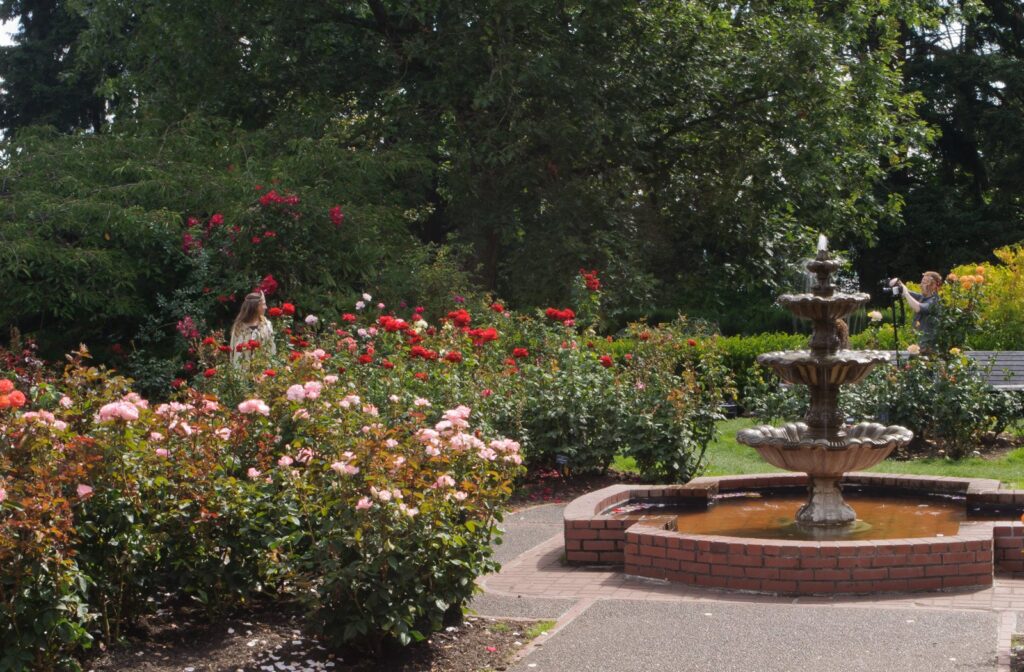
The Rose Test Garden is free and open from 5 a.m. to 10 p.m., apart from a 5-to-10 a.m. maintenance closure every other Wednesday from May through August. More than 10,000 bushes of over 610 varieties bloom from late May into October. The garden has shaped Portland’s Rose City identity since 1917, and it’s the oldest continuously operating public rose test garden in the United States. A free tour leaves at 1 p.m. daily from Memorial Day to Labor Day. Out of season you’re looking at pruned beds, but the terraces still frame the city below.
Hoyt Arboretum
A short shuttle hop away, Hoyt Arboretum spreads more than 2,300 species over 190 ridge-top acres, with 12 miles of trails that mix pavement, packed dirt, gravel and some stairs. It’s free every day, and the visitor center at 4000 SW Fairview Blvd. is open daily from 10 a.m. to 4 p.m. In October, walk the Maple Trail, where the arboretum’s nationally accredited maple collection puts on its main fall show.
What isn’t free in Washington Park
The paid neighbors sit right beside the free ones. In September 2026, adult tickets cost $22.50 at the Portland Japanese Garden, $26 at the Oregon Zoo (bought online in advance) and $8 at the World Forestry Center. That’s fair value, but decide before you arrive, not at the gate.
Verdict: The best free half-day in the city, as long as you leave the car at the hotel. Think twice if it’s January and you’re coming for roses; in winter the draw is the view and Hoyt’s evergreens.
Route 2: Forest Park, the Witch’s Castle and Pittock Mansion’s free view
Forest Park is how Portland gets away with having a wilderness inside city limits: 5,200 acres and more than 80 miles of trails, free and open from 5 a.m. to 10 p.m. Its spine is the 30-mile Wildwood Trail, marked with blue diamond blazes, which starts at mile 0 by the Oregon Zoo and the Vietnam Veterans Memorial and runs north to NW Newberry Road. Dogs must be leashed, and e-bikes aren’t allowed.
The best free half-day hike starts at the Lower Macleay trailhead at the end of NW Upshur Street, which has ADA parking and sits less than a mile from the streetcar stop at NW 23rd Avenue and Marshall Street. The trail follows Balch Creek for 0.8 mile to the Witch’s Castle, a mossy stone ruin, where it meets the Wildwood. Turn south and keep climbing: the Forest Park Conservancy puts the Pittock Mansion overlook at 2.5 miles, with nearly 450 feet of climbing.
Pittock Mansion’s grounds
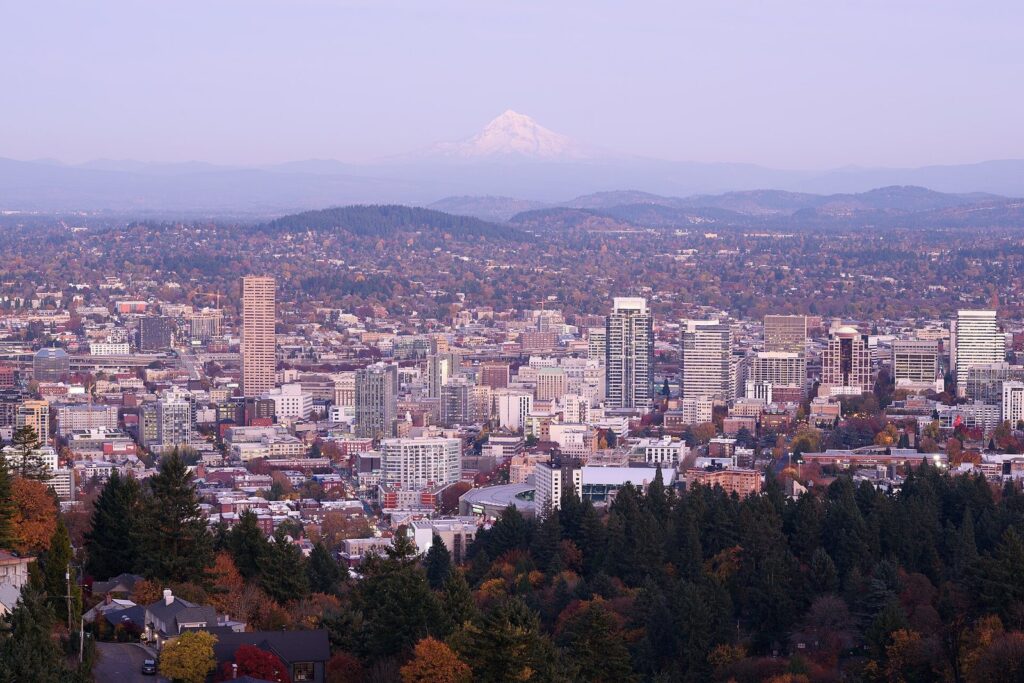
The house is a ticketed museum ($17 for adults in September 2026), but the lawn and viewpoint around it are a public park, free and open daily until 9 p.m. On a clear day the view runs east over downtown to Mount Hood. If you drive, know that the mansion’s lot is part of Portland Parks & Recreation’s pay-to-park system. Free parking is limited to gravel turnouts along NW Pittock Drive, a walk below the house, and they fill fastest from June through August and again in November and December.
Verdict: Worth a morning even if you only make it to the Witch’s Castle. Think twice if it has rained for days; between November and March the dirt trails get muddy, and Leif Erikson Drive, an old gravel road running 11.2 miles from the NW Thurman Street trailhead, is the better bet. For more trails in and beyond the city, see our roundup of hikes in Portland.
Is the 4T loop worth paying for the tram?
The 4T is the city’s best cheap adventure, though not a free one. It strings together Train (MAX to Washington Park), Trail (up the Marquam Trail to Council Crest, then down through Marquam Nature Park or city streets to Oregon Health & Science University), Tram (the Portland Aerial Tram down to South Waterfront) and Trolley (the Portland Streetcar back downtown). Council Crest Park, at 1,073 feet, is the highest point in Portland. The hiking section covers 3.5 or 4.1 miles, depending on the way down, and takes two to three hours.
Here’s the catch older guides get wrong: the tram isn’t free going down. Its fare page says everyone boarding at either terminal needs a fare. A $9 round trip is valid through the end of the operating day, and children 6 and under ride free with a paying adult. The tram runs weekdays from 5:30 a.m. to 9:30 p.m. and Saturdays from 9 a.m. to 5 p.m., with no service on Sundays or holidays. With TriMet’s $5.60 day cap, the full loop costs an adult $14.60.
Verdict: Worth the $9 on a clear weekday or Saturday. On a Sunday, keep it free: walk the 1.3 miles from Washington Park up to Council Crest, take in the view and walk back the way you came.
Route 3: The river loop, Waterfront Park and Saturday Market
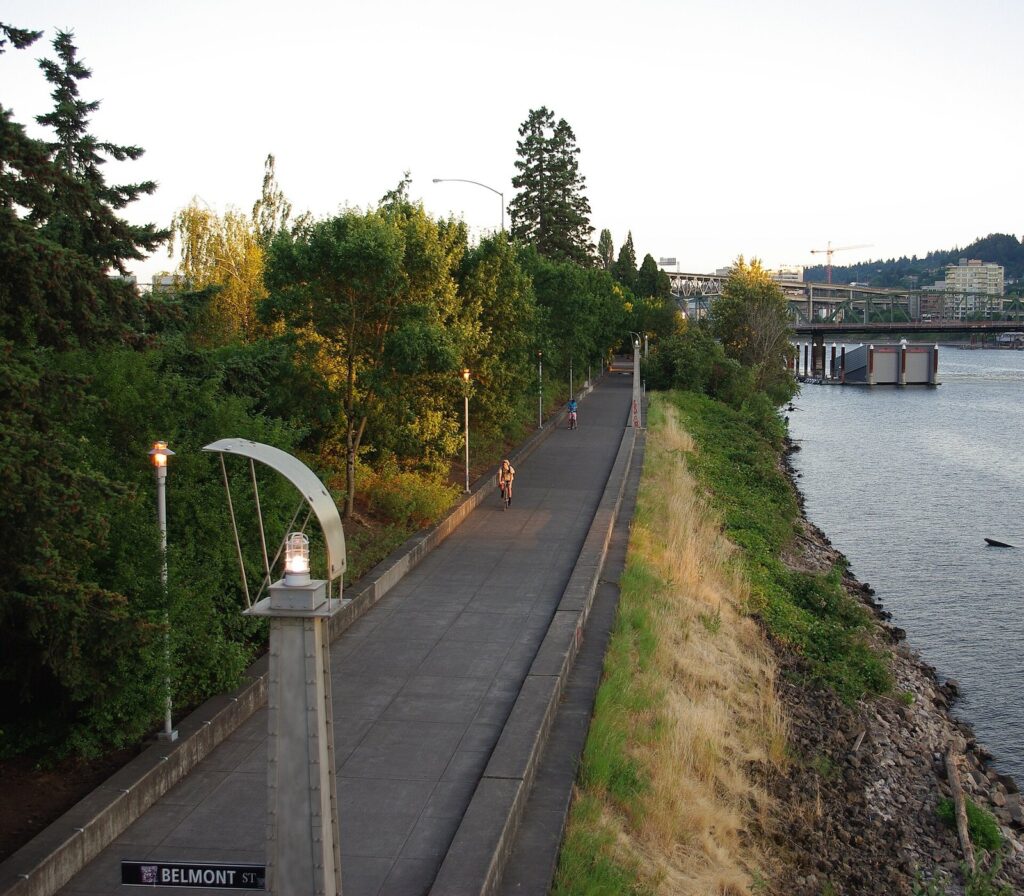
The free walk every first-time visitor should take is the loop along both banks of the Willamette. Start in Tom McCall Waterfront Park on the west bank, cross the lower-deck walkway of the Steel Bridge and come back along the Vera Katz Eastbank Esplanade, which runs 1.5 miles between the Steel and Hawthorne bridges and includes a 1,200-foot floating walkway, the longest of its kind in the United States. Cross back on the Hawthorne Bridge and you’ve walked about three miles, since the west bank between those bridges is a similar distance. Add Tilikum Crossing, the car-free bridge for transit, bikes and people on foot, to stretch it to about five.
Mill Ends Park
In the median of SW Naito Parkway at Taylor Street sits Mill Ends Park, two feet across and 452 square inches in all. Guinness has listed it as the world’s smallest park since 1971, and it became an official city park on St. Patrick’s Day, 1976. Allow ten seconds to see it, plus however long it takes to find it.
Portland Saturday Market
The arts-and-crafts market at 2 SW Naito Parkway is free to wander, and so is the people-watching. In 2026 it runs on Saturdays only, from 10 a.m. to 5 p.m., through December 19, so older advice about weekend markets no longer applies. Budget for lunch anyway: browsing is free, but the food booths are persuasive.
Poet’s Beach, in summer
Poet’s Beach, by the Marquam Bridge on the west bank, has a roped swim area with floats in summer. There’s no lifeguard, and the city tests the water weekly in summer, so check the latest result before you wade in.
Verdict: The single best free hour in Portland, morning or evening. Think twice if it’s a windy day with sideways rain; the river gives you no cover at all.
Route 4: Downtown’s free culture: Powell’s, the library and the Park Blocks
Downtown packs the most free indoor time into the smallest area, which makes it the rainy-day route. Start at Pioneer Courthouse Square, the brick plaza at the center of downtown, then walk a few blocks to Portlandia, the kneeling copper figure above the entrance of the Portland Building on SW Fifth Avenue. Installed in 1985 on Michael Graves’s 1982 building, she’s the second-largest hammered-copper statue in the United States, after the Statue of Liberty.
Central Library
Multnomah County’s Central Library, at 801 SW 10th Ave., reopened in 2024 after a renovation that added a terrace, better ADA access, a teen space and a refreshed children’s area. It’s free, warm and dry, which on a November afternoon covers most of what you need. All county libraries now keep the same hours, posted on the library’s website.
Powell’s City of Books
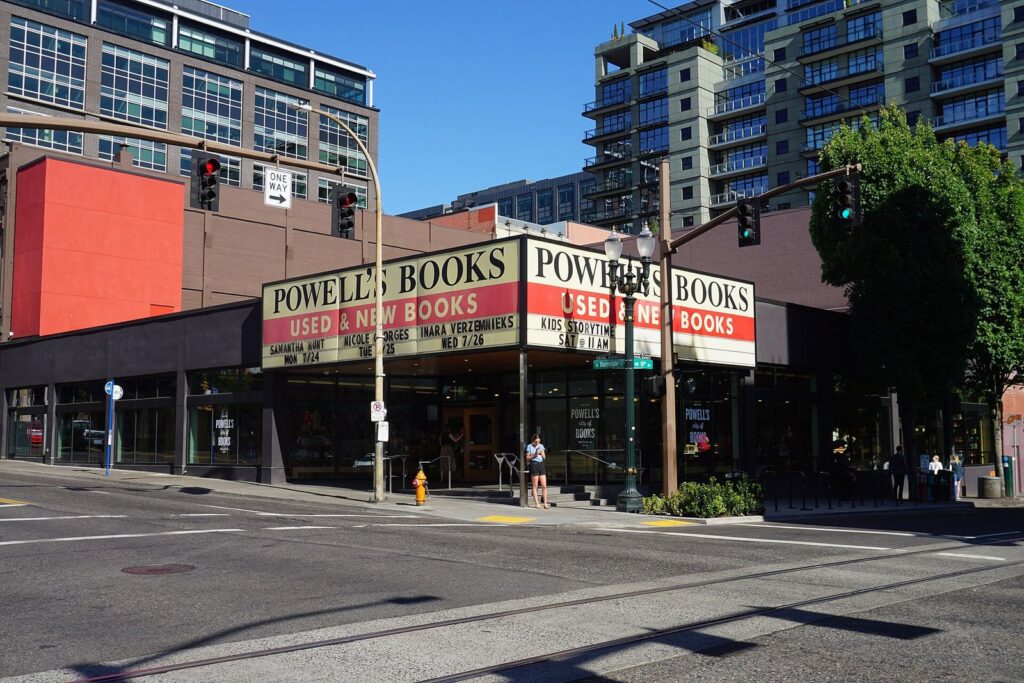
Powell’s flagship at 1005 W Burnside St. bills itself as the world’s largest independent bookstore, and it’s open daily from 10 a.m. to 9 p.m. Browsing costs nothing. The Rare Book Room, with autographed first editions and collectible volumes, keeps shorter hours, 10 a.m. to 5 p.m. The color-coded rooms are easy to lose an afternoon in, which is rather the point.
The South Park Blocks
The leafy South Park Blocks hold the Portland Art Museum, Oregon’s largest, with more than 42,000 works in two historic buildings now joined by the Mark Rothko Pavilion, which opened November 20, 2025. Adult admission is $27.50, but entry is free for anyone 17 or younger, and free for everyone from 10 a.m. to 7 p.m. on the first Thursday of each month. Our Portland museums and art guide covers what the paid museums are worth.
On Saturdays, the Portland Farmers Market at PSU fills the blocks at SW Park Avenue and SW Montgomery Street with up to 100 stalls, open 8:30 a.m. to 2 p.m. through October 2026 and 9 a.m. to 2 p.m. from November 7 into March 2027. Walking the stalls is free. For a cheap lunch between free stops, the pods in our Portland food carts guide beat any sit-down menu downtown.
First Thursday in the Pearl
On the first Thursday evening of each month, Pearl District galleries stay open late, generally from about 6 to 9 p.m., with free receptions. From April to October, the First Thursday Street Gallery also closes NW 13th Avenue between Hoyt and Kearney streets from 5 to 10 p.m. The next dates are November 5 and December 3, 2026, then January 7, February 4 and March 4, 2027. Pair it with the art museum’s free hours: the NS Line streetcar, which runs along SW 10th and 11th avenues just west of the museum, continues north into the Pearl.
Verdict: The best free rainy day in Portland, and the one route where most of the free things are indoors. Think twice if you’re here on a Monday, when the art museum is closed; Powell’s is open daily.
Route 5: The east side: Ladd’s Addition, Laurelhurst and Mount Tabor at sunset
East of the river, free Portland means leafy blocks, old parks and a volcano with a view. Ladd’s Addition, between SE Hawthorne Boulevard and SE Division Street from SE 12th to SE 20th avenues, is an early planned neighborhood laid out on diagonal streets around a central circle, with small public rose gardens tucked into the grid. It’s a pleasant 20-minute detour and a fine place to get briefly lost.
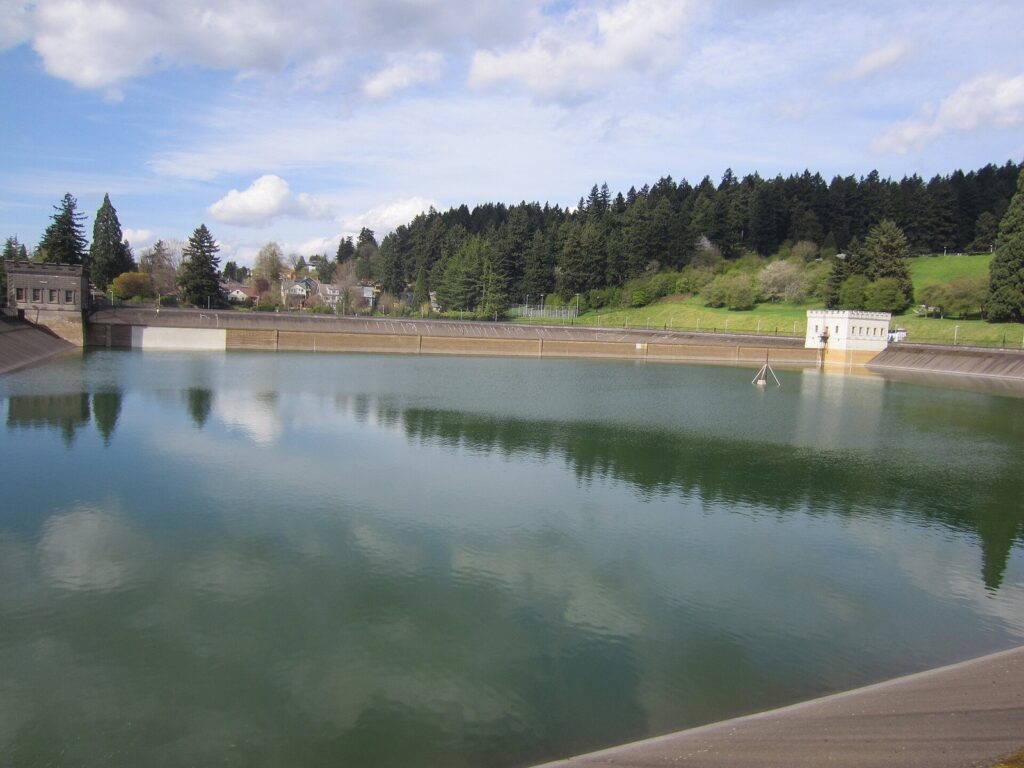
About two miles northeast, Laurelhurst Park was laid out along ideas from the Olmsted plan, with big trees, a pond, dog-friendly areas and some of the city’s best fall color. Then there’s Mount Tabor, a volcanic cinder cone in the middle of a residential neighborhood. The city built two open reservoirs on it in 1894 and two more in 1911; the three that remain open no longer supply drinking water, but they’re why the park looks like nowhere else. It’s open from 5 a.m. to 10 p.m., and three mapped loops (red, green and blue) of about one to three miles start at the kiosk in the main parking lot. The summit is a favorite spot at sunset.
Frequent buses make this route easy without a car: line 14 runs along Hawthorne, FX2 along Division and line 15 along Belmont. Walk it all instead, and the day costs nothing.
Verdict: The best free evening in the city from late spring to early fall. Think twice if you need to drive to the top on a Wednesday, when the park roads are closed to cars all day; they also close from 10 p.m. to 5 a.m. on other days.
Route 6: North and Northeast: the Grotto, Peninsula Park and Cathedral Park
The Grotto
The National Sanctuary of Our Sorrowful Mother, known to almost everyone as the Grotto, sits off NE Sandy Boulevard at NE 85th Avenue, and its Plaza Level is free during the day. That includes the chapel, the grotto itself (a rock cave cut into the base of a cliff, with a marble replica of Michelangelo’s Pietà), the St. Peregrine Shrine, the gift shop, the interpretive center and the Stations of the Cross path through the trees. You don’t need to be Catholic to appreciate the quiet; you do need to respect it. TriMet’s line 12 runs along Sandy Boulevard.
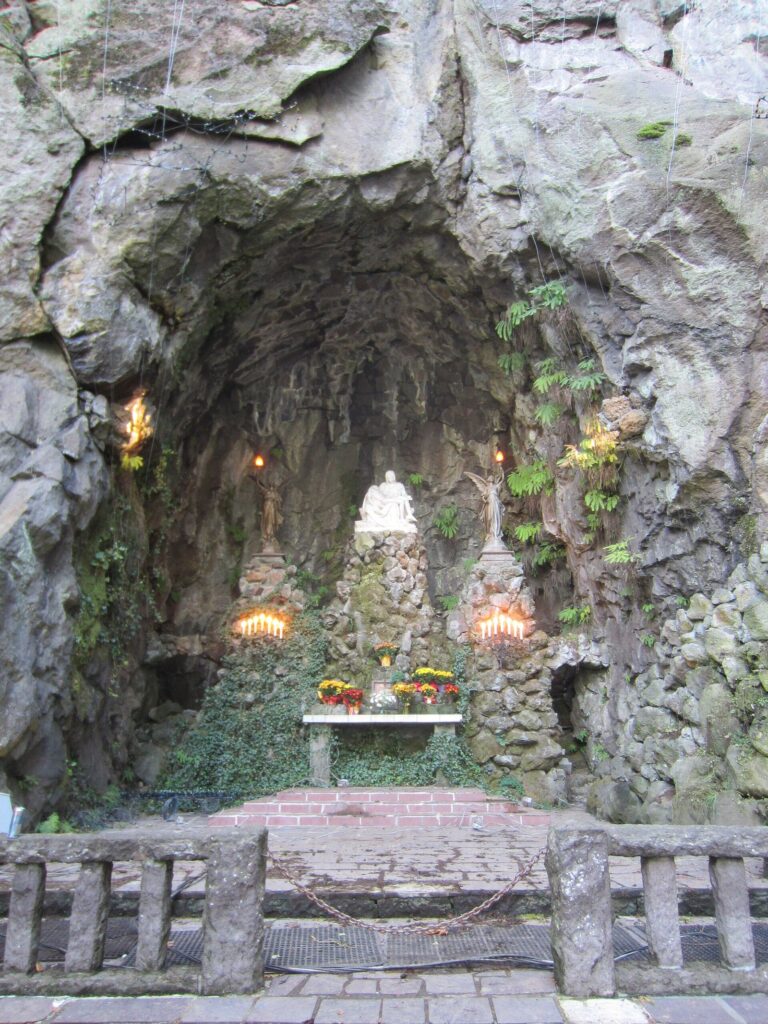
The Upper Gardens on the clifftop are paid: $11.95 for adults, $10.95 for seniors 65 and older and $5.95 for ages 6 to 11. The Grotto’s website says the Upper Gardens close from October 5 through the end of January while their elevator is modernized and that the free Plaza Level stays open, so check the hours page if the clifftop is on your list.
Peninsula Park Rose Garden
If Washington Park’s roses are the showpiece, Peninsula Park off N Rosa Parks Way is the neighborhood version: a formal sunken rose garden with clipped hedges and a central fountain, free to wander and well off the tour-bus circuit.
Cathedral Park and Kelley Point Park
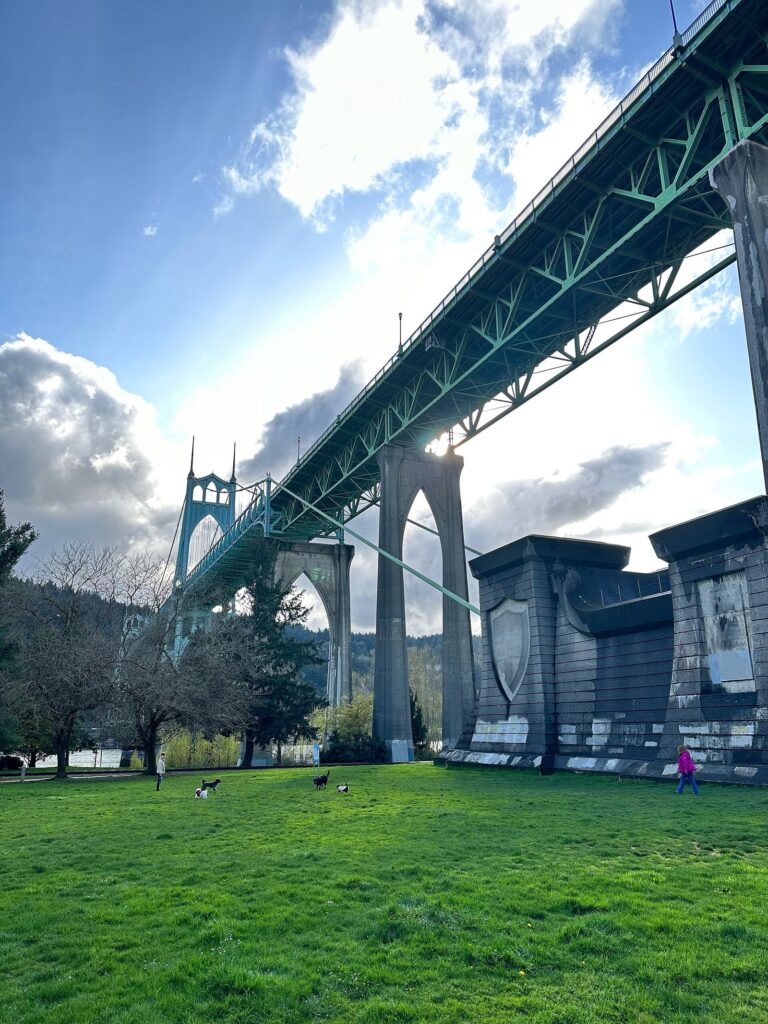
In St. Johns, Cathedral Park spreads out beneath the St. Johns Bridge, whose Gothic-arched towers explain the name. It was a junkyard until the 1970s and is now one of the city’s best fall-color spots. Farther north, Kelley Point Park sits where the Willamette meets the Columbia, a free, slightly wild place to watch ships go by.
Verdict: Worth it if you’re staying north or northeast, or have a car for the afternoon. Think twice if you’re downtown with two hours to spare; the river loop gives you more for the time.
Free nature on the edges: Oaks Bottom, Tryon Creek and Leach
These three sit farther from downtown and repay the trip if you have a car or a long bus ride in you. Our guide to Portland’s parks and gardens covers the paid gardens as well.
Oaks Bottom Wildlife Refuge. At SE 7th Avenue and Sellwood Boulevard, the paved North Woodland Trail and the Oaks Bluff Trail make an easy one-mile round trip from the north parking lot through riverside wetland. Dogs must be leashed.
Tryon Creek State Natural Area. Off SW Terwilliger Boulevard, Tryon Creek has about 14 miles of hiking trails, a 3-mile paved bike trail and a quarter-mile paved, all-accessible trail. The nature center is open daily from 9 a.m. to 4 p.m., and park hours run 7 a.m. to 7 p.m. in October and 7 a.m. to 6 p.m. from November through February. Oregon state parks are always free on foot, by bike or by transit; if you drive, check the park’s page for whether a day-use parking permit applies.
Leach Botanical Garden. Leach charges $5 (5 and under free), but its Garden for All program gives free admission to anyone who asks, so it earns a place here. It’s open Wednesday through Sunday from 10 a.m. to 4 p.m. (last entry 3:30), with the main entrance at 12323 SE Claybourne St. and the Aerial Tree Walk in the Upper Garden.
Which “free” Portland attractions aren’t free anymore?
Free lists age badly. These are the claims that turn up most often in older roundups, set against what the operators said in late September and on October 1, 2026.
| Place | What older lists say | What’s true in 2026 |
|---|---|---|
| Oregon Rail Heritage Center | Free | Admission since January 2026: $6 for adults 14 and up, $5 for seniors and military, $4 for ages 3-13; open Thursday to Sunday, 1-5 p.m. |
| Portland Aerial Tram | Free going down | A fare is required at both terminals; $9 round trip, valid all day |
| Portland Saturday Market | Saturdays and Sundays | Saturdays only, 10 a.m.-5 p.m., through December 19 |
| Washington Park | Free | Free to enter; parking $2.40 an hour, up to $9.60 a day |
| Leach Botanical Garden | Free | $5, or free to anyone who asks |
| Oregon Historical Society | Free | Free for Multnomah County residents with proof; $10 for visitors |
| Multnomah Falls | Free | Free to see; a $2 timed permit (plus a $2 fee) was required to park at I-84 Exit 31 from May 22 to September 7, 2026 |
| Portland Children’s Museum | Cheap with kids | Closed for good |
When in doubt, the operator’s own hours page beats any roundup, including this one.
Free things to do in Portland by season, fall 2026 to summer 2027
Some of the best free moments in Portland happen in a narrow window. Here’s the calendar from this fall forward.
| When | Free thing | Details |
|---|---|---|
| Mid-October to early November | Fall color | Hoyt’s Maple Trail, Laurelhurst Park and Cathedral Park |
| October 29, 2026 | Last Thursday on Alberta | 6-9 p.m. on NE Alberta Street |
| November 5 and December 3, 2026 | First Thursday | The art museum free 10 a.m.-7 p.m.; Pearl galleries in the evening |
| From November 7, 2026 | Farmers market, winter hours | Saturdays 9 a.m.-2 p.m. at PSU; closed December 26 |
| December 7, 2026 | Christmas Ships on the Willamette | 7-9 p.m., from Johns Landing to the Fremont Bridge and back; watch from either bank |
| February 5-13, 2027 | Portland Winter Light Festival | Free light art across the city |
For peak timing park by park, see our Portland fall foliage guide, and for month-by-month weather and events, our guide to the best time to visit Portland.
Free things to do in Portland with kids
Kids make free days easier here. Children 6 and under ride TriMet free with a paying rider, 7- to 17-year-olds pay $1.40, and the Portland Art Museum is free every day for anyone 17 or younger, so a family visit costs only the adult tickets.
The best free kid stops are the ones with room to run: the Rose Garden’s lawns, the Esplanade’s floating walkway, Mount Tabor’s trails, Oaks Bottom’s short paved loop and the refreshed children’s area at the Central Library. In Northeast Portland, Grant Park has bronze statues of Ramona Quimby, Henry Huggins and his dog Ribsy, characters created by Beverly Cleary, who grew up in the neighborhood. The Portland Children’s Museum has closed for good, whatever older lists say. Our Portland with kids guide covers the paid family favorites.
Can you do free Portland without stairs or steep hills?
Mostly, because the West Hills really are hills. Washington Park’s MAX station is reached by elevator, and Hoyt Arboretum has paved trails alongside its dirt ones. The flattest free route in the city is the river loop, where Waterfront Park and the Eastbank Esplanade both have paved paths along the water. Tryon Creek has a quarter-mile paved, all-accessible trail, Oaks Bottom’s North Woodland Trail is paved, and the Lower Macleay trailhead in Forest Park has ADA parking. The Central Library’s 2024 renovation improved ADA access.
Two places need a heads-up. Mount Tabor’s park roads close to cars all day on Wednesdays, so plan a summit drive for another day. At Pittock Mansion, the free turnouts sit below the house, so anyone who can’t manage the uphill walk should use the paid lot. TriMet’s Honored Citizen fare is $1.40 a ride, capped at $2.80 a day and $28 a month.
Free things to do near Portland, and the permits that aren’t
The Columbia River Gorge has the region’s most famous free sights, with strings attached. Vista House at Crown Point is free to enter, though its hours change by season and it closes when winds top 50 mph. Multnomah Falls is free to see, but in 2026 a timed use permit was required from May 22 to September 7 to park in the I-84 Exit 31 lot between 9 a.m. and 6 p.m.: $2 plus a $2 Recreation.gov fee per vehicle, and it didn’t guarantee a space.
Oregon state parks are free if you walk, bike or arrive by transit. Drivers pay a day-use parking fee of $10 a day for Oregon residents or $12 for out-of-state visitors, and since March 30, 2026 that fee applies at 22 more parks, including the Gorge trailheads at Latourell Falls, Bridal Veil Falls and Angel’s Rest. The Columbia Gorge Express bus runs seven days a week from Gateway Transit Center to Multnomah Falls and Hood River. Our Columbia River Gorge guide has the details, and our day trips from Portland page covers the coast, Mount Hood and wine country.
Once the free list runs out, our main Portland things-to-do guide sorts the paid attractions by what they’re worth.
Free Things to Do in Portland FAQ
Is the Portland Aerial Tram free going down?
No. The tram’s fare page says everyone boarding at either terminal needs a fare, so hiking up and riding down free no longer works. A $9 round trip is valid until the end of the operating day, children 6 and under ride free with a paying adult, and you can buy online or by card at either terminal.
What’s free to do in Portland on a Sunday?
Most of the big free list works on Sundays: Washington Park’s gardens, Forest Park, Pittock’s grounds until 9 p.m., the river loop, Mount Tabor and Powell’s from 10 a.m. to 9 p.m. Two things don’t. In 2026, Portland Saturday Market runs on Saturdays only, and the Aerial Tram doesn’t run on Sundays, which rules out finishing the 4T loop.
Is there anything free to do in Portland at night?
Yes. The International Rose Test Garden stays open until 10 p.m., Pittock Mansion’s grounds and Powell’s until 9. On the first Thursday of each month, Pearl District galleries host free receptions from about 6 to 9 p.m., and on the last Thursday, NE Alberta Street holds an art walk from 6 to 9 p.m., ten months a year.
Do you need a car for free things to do in Portland?
Not for most of them. MAX, the streetcar and frequent buses reach Washington Park, downtown, the east side and the Grotto, and fares stop at $5.60 a day. A car helps for Kelley Point Park and the Gorge, although the Columbia Gorge Express reaches Multnomah Falls daily from Gateway Transit Center. Parking at Washington Park alone can cost $9.60.
Which Portland museums are free?
None of the big ones is free every day for adult visitors. The Portland Art Museum is free on the first Thursday of each month from 10 a.m. to 7 p.m., and always free for anyone 17 or younger. The Oregon Jewish Museum and Center for Holocaust Education admits SNAP recipients and Blue Star families free, and the Japanese American Museum of Oregon admits children 11 and under free.
Related Portland Guides
- Things to Do in Portland, Oregon: the paid headliners, what they cost and how to split your time
- Portland, Oregon Parks and Gardens: every major park and garden, free and paid, with transit for each
- Getting Around Portland, Oregon: fares, MAX lines, the streetcar, bikes and parking
- Portland, Oregon Itinerary: 1, 2, 3 and 4 Days: day-by-day plans that mix free and paid stops
- Portland, Oregon Neighborhoods Guide: which district suits which kind of free afternoon
Sources and verification
The details on this page were checked between September 23 and October 1, 2026 against the agencies and operators listed below; the guide is compiled from their published information and claims no first-hand visits.
- TriMet: fares and caps and youth fares
- Explore Washington Park: free shuttle and parking
- Portland Parks & Recreation: International Rose Test Garden
- Hoyt Arboretum: plan your visit
- Portland Parks & Recreation: Forest Park and Forest Park Conservancy: Lower Macleay Trail
- Pittock Mansion: the grounds and parking
- 4T Trail and Portland Aerial Tram: fare
- Portland Parks & Recreation: Eastbank Esplanade, Mill Ends Park and Poet’s Beach
- Portland Saturday Market: hours and Portland Farmers Market at PSU
- Portland Art Museum: admission and Oregon Historical Society: plan your visit
- Multnomah County Library: Central Library reopening
- Powell’s City of Books
- Explore the Pearl: First Thursday and Last Thursday on Alberta
- Portland Parks & Recreation: Mt. Tabor Park and Portland Water Bureau: Mt. Tabor reservoirs
- The Grotto: hours and admission
- Oaks Bottom Wildlife Refuge, Powell Butte Nature Park and Leach Botanical Garden
- Oregon State Parks: Tryon Creek and day-use parking permits
- Oregon Rail Heritage Foundation: visit
- ODOT: waterfall corridor permits and Oregon State Parks: Vista House
- Christmas Ships: parade schedule and Portland Winter Light Festival
- NOAA: U.S. climate normals, 1991-2020
Portland Tourism Guide is an independent publication, not affiliated with Travel Portland, the City of Portland or any business named here.
Photo credits
- Mount Tabor Park reservoir: photo by Another Believer, Wikimedia Commons (CC BY-SA 3.0)
- International Rose Test Garden: photo by InSapphoWeTrust from Los Angeles, California, USA, Wikimedia Commons (CC BY-SA 2.0)
- View from Pittock Mansion: photo by King of Hearts, Wikimedia Commons (CC BY-SA 4.0)
- Eastbank Esplanade: photo by M.O. Stevens, Wikimedia Commons (CC BY-SA 4.0)
- Powell's City of Books: photo by Michael Barera, Wikimedia Commons (CC BY-SA 4.0)
- The Grotto: photo by Another Believer, Wikimedia Commons (CC BY-SA 4.0)
- Cathedral Park and the St. Johns Bridge: photo by FormalDude, Wikimedia Commons (CC BY-SA 4.0)